
 Available in US
Content

A Map of Every Golf Betting Market
When I started betting on golf in 2017, the market menu was short: outright winner, each-way, a handful of matchups and maybe a first round leader if you looked hard enough. Today, a single PGA Tour event can offer 30 or more distinct market types, from outright and top finishes to hole-by-hole micro-markets and same-game parlays. The PGA Tour’s betting handle grew by 20% in 2025 alone — the fourth consecutive year of double-digit growth — and that expansion has been fuelled in large part by the sheer variety of ways punters can now engage with a tournament.
But variety isn’t the same as value. More markets means more opportunities to bet, but it also means more opportunities to bet badly. Each market has its own mechanics, its own settlement rules, its own quirks and its own risk profile. Treating them as interchangeable is a fast route to an empty bankroll. What follows is a reference guide to every major golf betting market available to UK punters, written to be dipped into whenever you encounter a market type you’re not sure about. I’ve organised them from the most common (outright winner) to the newest (micro-markets), with the mechanics, typical odds ranges and practical considerations for each.
Think of this as the map. You don’t need to visit every destination on it — in fact, I’d argue that specialising in two or three markets is more profitable than dabbling in all of them. But knowing the full terrain means you can make informed choices about where to focus, and you won’t be caught off guard when a bookmaker offers a market you’ve never seen before.
Outright — Tournament Winner
The first golf bet I ever placed was an outright winner bet. I backed a 25/1 shot at The Open because I liked his swing. He finished 47th. That’s outright betting in a nutshell — exhilarating in theory, humbling in practice, and the foundation of every golf betting market.
An outright bet is a wager on a single player to win the tournament. It’s settled after the final round, with play-off results counting (a play-off winner pays out as the tournament winner). The odds reflect the bookmaker’s assessment of each player’s probability of winning, and in a 156-player field those odds are naturally long. Even the tournament favourite is typically priced between 6/1 and 12/1, while mid-tier contenders sit at 30/1 to 60/1 and outsiders can be 150/1 or longer.
The PGA Tour’s total prize money for the 2026 season is 450 million dollars, with every Signature Event carrying a purse of 20 million. That concentration of money at the top of the field means the best players enter more events than ever, which in turn makes outright markets more competitive. The favourite’s implied win probability rarely exceeds 12%, and the market is distributed across a wide range of genuinely credible contenders.
For UK punters, outright bets come in two flavours: ante-post (placed before the tournament week, sometimes months in advance) and day-of-tournament. Ante-post prices are typically more generous because they carry withdrawal risk — if your player doesn’t start, some bookmakers void the bet but others don’t. The timing trade-off is straightforward: earlier prices offer better value but more uncertainty; later prices are tighter but you know the player is actually teeing up.
My approach to outright betting is selective. I place outright win bets only when my data analysis identifies a genuine edge at the available price — which happens perhaps three or four times a season. For most events, the each-way and top-finish markets offer better expected value than a straight win bet on the same player. Outright is the glamour market, but it’s not always the smartest one.

Top 5 / Top 10 / Top 20 Finishes
If outright is the lottery ticket, top-finish markets are the dividend stocks of golf betting. Lower payout, higher hit rate, and far more suited to a systematic approach. I’ve placed more top-finish bets than any other market type over my career, and they’re the backbone of my weekly routine.
Top-5, top-10 and top-20 markets are exactly what they sound like: your player needs to finish inside the specified position for the bet to win. The odds compress as the range widens — a player at 50/1 outright might be 8/1 for a top-five finish, 3/1 for a top-ten and 6/4 for a top-twenty. Settlement is based on the official final standings, and dead heat rules apply if players are tied at the boundary position.
The dead heat issue is worth flagging here because it’s more common than many punters realise. If four players tie for fifth and you’ve backed one of them in the top-five market, only one “place” is available for four players. Your stake is divided by four, and you’re paid at the top-five odds on one quarter of your stake. The net result is substantially less than a clean top-five finish, and it happens regularly at tour level where scoring ties are the norm rather than the exception.
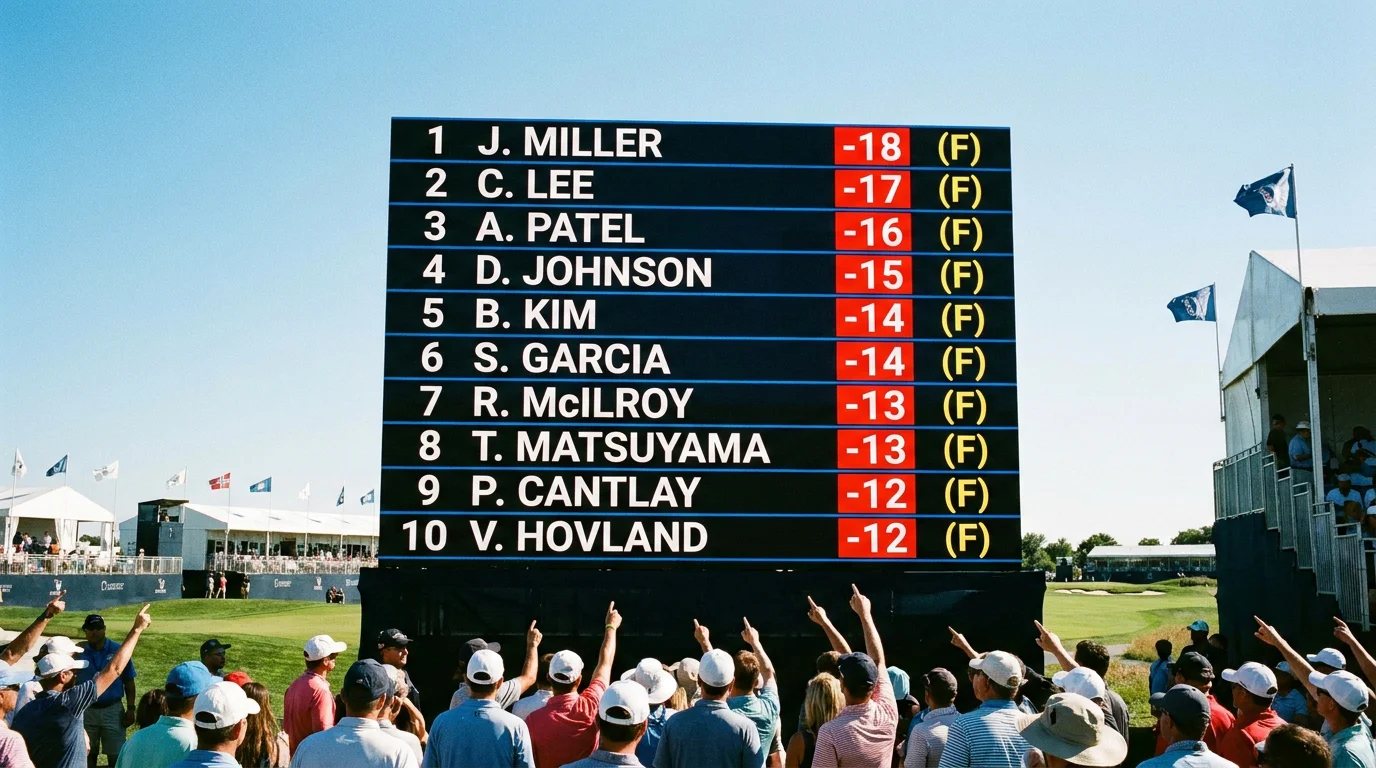
The strategic appeal of these markets is predictability. A player with ten top-ten finishes in his last twenty starts is a far more reliable bet for a top-ten this week than he is for an outright win. The variance is lower, the probability estimates are more accurate, and the resulting edge — when it exists — is easier to identify and exploit. I use top-ten markets as my primary vehicle for players in the 20/1 to 40/1 outright range, and top-twenty for the 50/1 to 80/1 range where the each-way place terms are less generous.
Head-to-Head and Group Matchups
Matchup betting strips golf down to a two-horse race. Forget the other 154 players in the field — your bet is on which of two named players finishes higher in the tournament standings. It’s a fundamentally different proposition from outright or top-finish betting, and it demands a fundamentally different type of analysis.
The standard matchup covers the full 72 holes. Player A vs Player B, whoever has the lower total score wins. If one player misses the cut and the other makes it, the player who makes the cut wins the matchup regardless of final position. If both miss the cut, the player with the lower 36-hole total typically wins (check settlement rules, as these vary between bookmakers). If both finish on the same score, the bet is usually voided and stakes returned — though some operators offer a three-way market with a “tie” option at longer odds.
Round matchups — where the bet covers only one round rather than the full tournament — are a separate market. These are popular because they offer daily action and sidestep the weekend cut issue entirely. The downside is thinner odds and less time for statistical edges to play out. I use round matchups sparingly, mainly on Thursdays when the full field is in play and the morning/afternoon tee time split (the “wave” effect, where different groups face different wind and course conditions) creates exploitable advantages.
Group matchups — three-ball bets in round formats — pit three players against each other for a single round. These carry higher dead heat risk (three-way ties for the lead of a group are not uncommon) and typically offer a “tie” option alongside the three named players. The odds are shorter than in outright markets, usually between 6/4 and 7/2 per player, and the analysis centres on head-to-head statistical comparisons in specific skill areas. If this week’s course favours driving accuracy and Player A ranks 10th on Tour in that metric while Player B ranks 85th, the matchup tilts sharply toward A regardless of their overall rankings.
My matchup betting is focused on full-tournament head-to-heads where I’ve identified a clear statistical mismatch that the market hasn’t fully priced in. One or two per event at most — quality over volume.

First Round Leader
There’s something satisfying about having a bet settled by Thursday evening while everyone else waits until Sunday. First Round Leader — FRL — is the market for punters who want fast resolution and are willing to accept the pricing quirks that come with a one-round format.
The FRL market asks which player will hold the outright lead after the first 18 holes. If two or more players share the lead, dead heat rules apply — and they apply frequently, because first-round ties are common in professional golf. A field of 156 players with an average scoring range means shared leads occur in roughly 40-50% of PGA Tour events. That dead heat exposure is baked into the odds to some extent, but it still catches punters who don’t account for it.
Odds in FRL markets are naturally longer than outright markets for the same player, because leading after one round is arguably harder to predict than winning over four. The favourite is typically priced between 12/1 and 20/1, and outsiders can stretch well past 200/1. The market tends to favour players with strong early-round scoring records — a trackable statistic — and those who have historically performed well in the Thursday morning wave, when greens are freshest and conditions are often most benign.
I like FRL as a supplementary market rather than a primary one. The variance is high, the dead heat risk compresses returns, and the one-round timeframe limits how much skill-based edge your analysis can capture. But two or three times a season, a player’s Thursday scoring average, combined with a favourable tee time and strong course fit, creates a spot where the FRL price significantly overestimates the probability of the outcome. Those are the spots I target.

Make / Miss the Cut
The 36-hole cut is one of golf’s unique structural features, and it creates a betting market that doesn’t exist in most other sports. After two rounds, roughly half the field is eliminated. The cut line is determined by the lowest score that allows the top 65 players (plus ties) to advance. Everything below that line goes home.
Make/miss the cut markets offer binary odds on whether a specific player will survive Friday. For strong players in form, the “make the cut” price is short — often 1/4 or 1/3 — because the probability is genuinely high. For fringe players or those with poor recent form at the specific course, “miss the cut” can offer attractive odds in the 5/4 to 7/4 range.
The appeal of cut-line betting is in its simplicity and the availability of relevant data. A player’s cut-making percentage over the last 24 events is a reliable predictor — more reliable than outright winning probability over the same sample. Players who make the cut consistently tend to keep doing so, and players who miss cuts frequently tend to keep doing that too. The trait is sticky enough to model with reasonable accuracy.
Where the market gets interesting is at the margins. A player who’s made 15 of his last 20 cuts but is priced at 4/7 to make this one might offer no value. But a player who’s made 12 of 20 but is priced at 10/11 to make it at a course where his statistical profile is a strong fit — that’s a potential edge. I find one or two profitable cut-line bets per month, usually on “miss the cut” for short-priced favourites whose form at the specific venue type is weaker than their overall numbers suggest.
Top Nationality
One of the most overlooked markets on the card, top nationality betting asks which country will produce the highest-finishing player in the tournament. It sounds niche, but it offers a surprisingly different angle on the same field — and the pricing often reflects the fact that bookmakers spend less time modelling this market than the headline outright.
The mechanics are straightforward: the nationality with the best-placed player at the end of 72 holes wins the market. If an American finishes first and an Australian finishes second, the USA wins. If two players from different countries tie for the best position, dead heat rules apply. The market typically covers eight to ten nationalities, with the USA almost always shortest-priced given the depth of American talent on the PGA Tour.
The value lives in the second and third tier of golfing nations. Countries like South Korea, Australia, Japan, Sweden and South Africa have smaller but high-quality contingents on Tour. In weeks where one or two players from these nations are in excellent form while the American cohort is diluted across a weak field, the top nationality price for that smaller nation can be significantly too long. I find this market particularly useful around events that attract strong international fields — the WGC events, The Open and the DP World Tour’s biggest weeks — where non-American representation is at its highest.
It’s a market that rewards a different kind of research: instead of assessing one player, you’re assessing the best-case scenario from a group of three to six players. That portfolio effect smooths out some of the individual variance and makes the probability estimation more tractable than an outright pick.

Specials, Props and Same-Game Parlays
The fastest-growing segment of golf betting isn’t outright or each-way — it’s the explosion of prop markets and same-game parlays that let punters construct custom bets within a single event. The PGA Tour’s Betcast expanded from 50 hours of live betting coverage across six tournaments in 2025 to more than 400 hours across twelve tournaments in 2026, and that infrastructure has unlocked a new category of wagers that didn’t exist two years ago.
Props — short for proposition bets — cover outcomes beyond the final standings. Will a specific player shoot under par in round one? Will there be a hole-in-one during the tournament? Will the winning score be above or below a certain number? These are binary outcomes that bookmakers can price with varying levels of sophistication, and they attract punters who want engagement beyond “who wins.”
Same-game parlays take props a step further by combining multiple selections from within one event into a single bet. You might combine “Player A to make the cut” with “Player B to finish in the top ten” and “the winning score to be under -15.” The combined odds multiply, creating the potential for large returns from a small stake — but the correlation between legs matters enormously. If two of your selections are statistically linked (say, both depend on the course playing easy that week), the bookmaker adjusts the combined price downward to reflect that correlation. Scott Warfield described the Tour’s product development team as “looking at all sorts of opportunities to integrate into the live feed, like single game parlays and new micro markets,” and the pace of innovation shows no sign of slowing.
My honest assessment of specials and SGPs: they’re entertaining and they have a role in casual engagement with a tournament, but the margin embedded in combined bets is substantial. Each additional leg multiplies the bookmaker’s edge. I use SGPs very occasionally — perhaps once or twice during major championship weeks — and only when I’ve identified legs that I believe are positively correlated but priced as if they’re independent. That’s a rare edge, and chasing it weekly is a losing proposition.

Golf Accumulators
Accumulators — accas — combine two or more selections into a single bet where all legs must win for the bet to pay out. The combined odds are the product of the individual odds, which means even modest individual prices produce headline-grabbing potential returns. A four-fold acca with each leg at 3/1 pays 80/1 overall. Tempting. Also, almost certainly losing.
Golf accas work best when the individual legs are independently assessed markets with low correlation. Combining four matchup selections — Player A beats Player B in matchup 1, Player C beats Player D in matchup 2, and so on — is a cleaner acca structure than combining outright winners, because each leg can be analysed on its own merits and the outcomes are largely independent. Combining outright bets (Player X to win Event A and Player Y to win Event B across different weeks) is technically an acca but carries compounding uncertainty that makes the probability vanishingly small.
The honest reality of golf accas is that they’re a recreational product. The combined overround — the bookmaker’s built-in margin — multiplies with each leg, so a four-fold acca where each individual market has a 10% margin effectively carries a 46% margin on the combined bet. That’s a steep hill to climb. Profitable golf punters rarely use accumulators as a core part of their strategy; when they do, it’s for small stakes as an entertainment side bet alongside their primary single-bet activity.
If you’re going to build a golf acca, use matchup and top-finish legs rather than outrights, keep it to three legs maximum, and stake it at a fraction of your normal unit. Treat it as a bonus, not a strategy.
Micro-Markets and In-Play — An Overview
The newest frontier in golf betting is micro-market and hole-by-hole betting, where wagers are placed on individual holes or even individual shots during a live round. Hard Rock Bet launched micro-markets for the PGA Tour in 2026 — including hole winner, hole score and 3D shot tracking visualisations — available across ten US states. UK availability is still developing, but the direction of travel is clear: golf betting is moving toward granular, real-time engagement that mirrors what football and cricket punters have had for years.
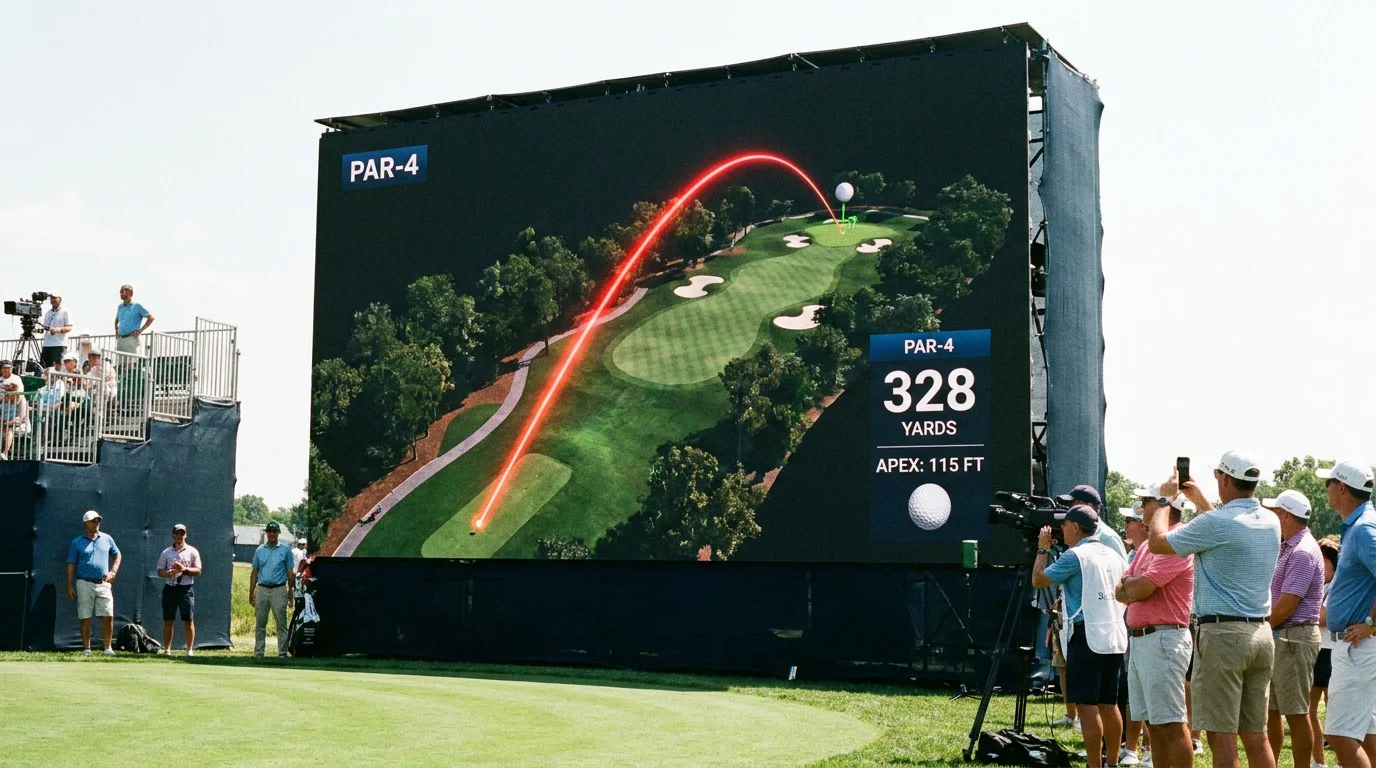
In-play betting on golf — wagering during a round rather than before the tournament starts — has been available at UK bookmakers for some time, but the market range and update speed have improved dramatically. Outright and top-finish odds now adjust after every completed hole for featured groups, and some operators offer round-by-round matchups that settle at the end of each 18-hole loop. The data infrastructure powering these markets comes from ShotLink tracking and Sportradar’s official data feeds, which we’ll explore in more detail across the live betting section of this site.
For now, the key point is this: micro-markets and in-play are adding layers of complexity and opportunity to golf betting that simply didn’t exist three years ago. If you’re the kind of punter who wants to engage with every shot, they’re here. If you prefer the slower pace of pre-tournament analysis and weekly bets, they’re entirely optional. Know they exist, understand the basics, and decide whether they suit your approach.
Golf Betting Markets FAQ
Which golf betting market offers the best value for beginners?
Top-finish markets — particularly top-ten and top-twenty — are the most forgiving starting point. The hit rate is higher than outright betting, the dead heat risk is lower than in FRL markets, and the analysis required is simpler: identifying players who consistently contend is easier than identifying tournament winners. Start with top-ten bets on players in the 25/1 to 50/1 outright range, and expand into other markets as your understanding deepens.
Are all golf markets available for every tournament, or do they vary?
Market availability varies significantly between events. Major championships and Signature Events typically offer the full menu: outright, each-way, top finishes, matchups, FRL, cut line, nationality, props and same-game parlays. Lower-tier tour events may only have outright, each-way and a limited matchup card. LIV Golf events have the thinnest UK market availability. Always check what your bookmaker is offering for a specific event before planning your bets.
How does field size affect the number of available markets?
Larger fields generate more markets because there are more possible outcomes to price. A 156-player PGA Tour event supports deep matchup cards, extensive top-finish markets and wide each-way terms. A 48-player LIV Golf event or a 72-player invitational has fewer matchup combinations, shorter outright odds across the board and typically narrower each-way terms. Field size also affects the cut line — smaller fields sometimes have no cut at all, which eliminates the make/miss the cut market entirely.
