
 Available in US
Content
Why I Stopped Ignoring Futures Markets
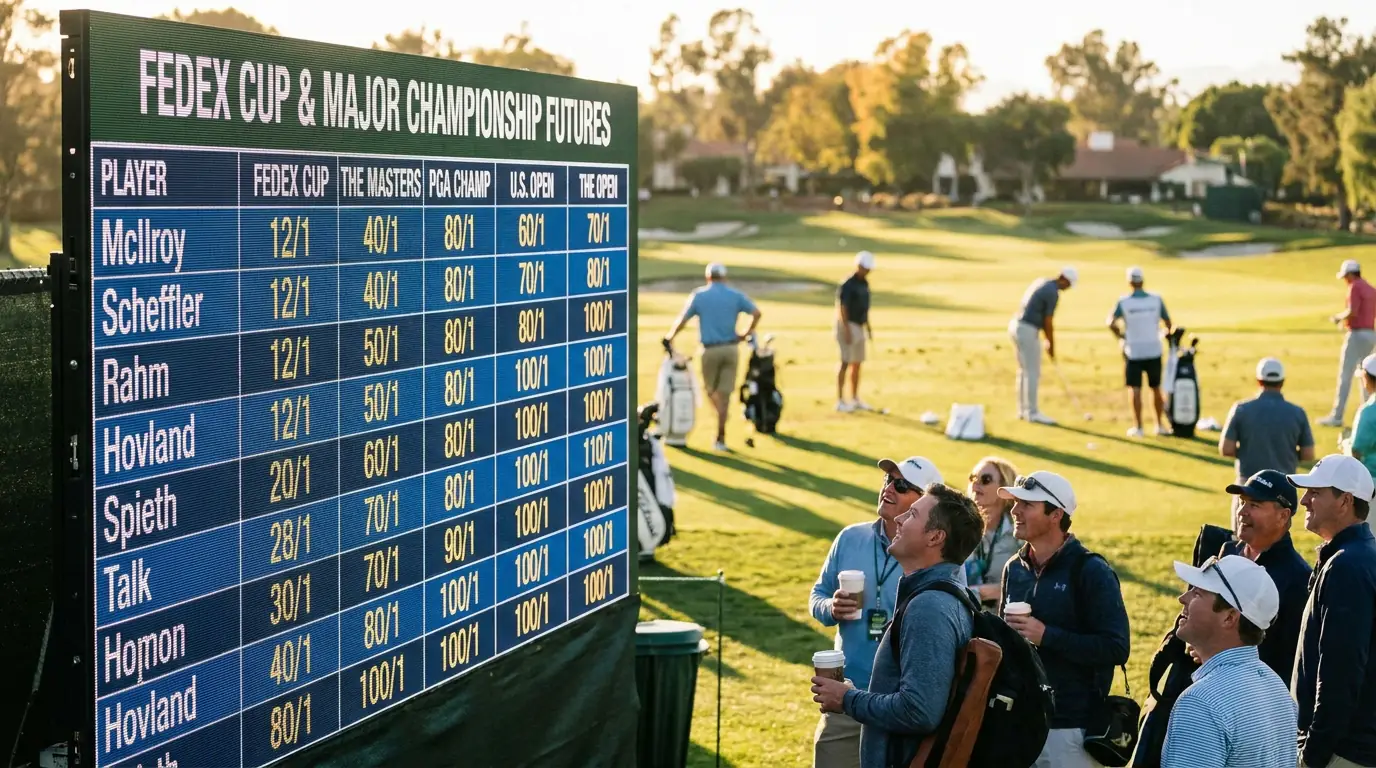
For years, I treated golf futures the way most punters do — as novelty bets placed in January and forgotten by March. Then in 2023, I backed a 40/1 FedEx Cup shot who finished third in the standings, and the each-way return changed how I thought about the entire season. Futures betting in golf means placing a wager on an outcome that will not be decided for weeks or months: who wins the FedEx Cup, who tops the DP World Tour Rankings, who claims the Race to Dubai, or which player will win a specific major before the field is even confirmed.
The appeal is structural. Golf futures markets are priced months in advance, and the bookmaker’s ability to forecast a 48-week season accurately is limited. The PGA Tour’s total prize pool for 2026 sits at $450 million, and that money reshapes fields and motivations throughout the year. Players peak, slump, get injured, and resurface — all of which creates pricing gaps that week-to-week tournament markets rarely offer.
FedEx Cup Futures and How the Points System Shapes Odds
I once backed a player for the FedEx Cup who was sitting 45th in the standings at the halfway point of the season. He won twice in the summer swing, vaulted into the top five, and suddenly his 66/1 pre-season price looked like theft. That is the nature of the FedEx Cup — a season-long points race where a hot streak at the right moment can overturn months of mediocre results.
The FedEx Cup awards points based on finishing position in every PGA Tour event, with elevated events and majors carrying the heaviest weighting. The top 70 players after the regular season qualify for the FedEx Cup Playoffs, and then the field is cut to 50 after the first playoff event, then 30 for the Tour Championship. The handle on FedEx Cup Playoffs events surges by roughly 50% compared to regular-season tournaments, and the Tour Championship itself has seen its handle double in recent years. That spike in betting volume reflects both the concentrated field and the winner-take-all drama.

From a pricing standpoint, pre-season FedEx Cup futures carry enormous uncertainty. The bookmaker is pricing 200+ players across a season that has not started yet. That uncertainty is your edge. Players who had quiet seasons but show strong underlying Strokes Gained numbers are routinely underpriced in January. Conversely, players coming off a career year tend to be over-backed by recreational bettors riding recency bias.
Major Championship Futures Before the Field Is Set
Backing a Masters winner in November feels absurd until you realise the price you get is 30% wider than what will be available on the Tuesday of tournament week. I place one or two major futures bets per year, always before the calendar turns to the month of the event, and the discipline has paid for itself over time.
Each major has its own quirks. The Masters returns to Augusta National every year, which means course form data is deep and reliable — a player who has gained strokes on approach at Augusta across five visits is a fundamentally different proposition from one making his debut. The Open Championship rotates between a smaller rota of links courses, and a player’s links pedigree matters enormously. The US Open and PGA Championship move to new venues more frequently, which reduces the value of course-specific history but increases the importance of general skill profiles like Strokes Gained: Off the Tee and approach play on long par fours.
The key with major futures is that withdrawals and form shifts between the time you place the bet and the tournament can work against you. If your player picks up a wrist injury in March and you backed him for the Masters in December, the bet stands and your stake is at risk. That is the ante-post trade-off, and it is why I never allocate more than 1–2% of my annual bankroll to any single futures wager. The wider prices compensate for the risk, but only if your staking reflects the uncertainty.

DP World Tour Rankings and Race to Dubai
Most UK punters focus their futures attention on the PGA Tour, and that is a mistake. The Race to Dubai — the DP World Tour’s season-long points competition — offers thinner markets with less sharp money, which means the pricing inefficiencies are larger and persist for longer.
The DP World Tour schedule runs from January through November, culminating in the DP World Tour Championship in Dubai. Points are awarded based on prize money earned, so victories in co-sanctioned events like The Open and the PGA Championship carry enormous weight. A player who wins one major and finishes well in two Rolex Series events can leapfrog 30 places in the rankings overnight.
I look for two types of value in Race to Dubai futures. First, young European players who are trending upward but have not yet broken through to the mainstream consciousness of UK bookmakers. Their prices stay inflated because the recreational market does not follow the Challenge Tour graduation pipeline the way serious bettors do. Second, established players who split their schedule between the PGA Tour and DP World Tour — they accumulate points on both circuits when events are co-sanctioned, which gives them more scoring opportunities than players committed exclusively to one tour. England Golf recorded 5.75 million scorecards in the first half of 2025 alone, a 29% year-on-year increase, and that growing grassroots engagement translates directly into more interest in PGA Tour betting markets among the UK punting population.

Timing, Staking and the Patience Problem
The biggest obstacle in futures betting is not analytical — it is psychological. You place a bet in January, and for six months nothing happens. Your player finishes 30th, then 45th, then misses a cut, and the temptation to write the bet off is overwhelming. I have learned to treat futures like a separate portfolio: place them, record them in a spreadsheet, and do not revisit the decision until the relevant window arrives.
Timing matters more than most bettors realise. Pre-season prices are widest, but they also carry the most uncertainty. Mid-season futures — placed after the first major, say — offer narrower prices but dramatically more information. A player who has already shown form through the spring swing and posted a top-ten at the Masters is a different proposition in May than he was in January. The pro golf market reached $7.6 billion globally in 2025, and that growth means bookmakers are now offering futures markets with more granularity and more frequent repricing than ever before.
My staking approach: I allocate 5–8% of my annual golf bankroll to futures bets, spread across four to six wagers. No single bet exceeds 2% of the total. If a mid-season opportunity arises where the data clearly supports a player at a dislocated price, I will add to my futures portfolio — but the total exposure stays within the 8% cap. This discipline sounds conservative, and it is. Futures are high-variance bets by definition. The edge comes from price, not volume.

When Futures Become Dead Money
Not every futures bet deserves to ride until the final event. If your FedEx Cup pick gets injured in June and is out for three months, the bet is effectively dead even though it technically remains active. I do not have a formal cash-out rule — most bookmakers do not offer cash-out on golf futures anyway — but I do adjust my mental accounting. A dead futures bet gets written off in my tracking spreadsheet, and the allocated bankroll is treated as spent. No replacement bet, no doubling down on another player to “make up” the loss.
The opposite scenario is more interesting: your player is flying, sitting fifth in the FedEx Cup standings, and a bookmaker offers you cash-out at a fraction of the potential return. My default answer is to let it ride. If the original analysis was sound and the player’s form confirms the thesis, taking a reduced payout is giving back the edge you identified at the start of the season. The exception is if the player’s underlying numbers have deteriorated — if he is gaining strokes primarily through unsustainable putting rather than ball-striking, the hot run is more fragile than it looks, and taking money off the table becomes the rational play.

Futures Betting FAQ
When is the best time to place a golf futures bet?
Pre-season offers the widest prices and the most value for bettors willing to accept the uncertainty. Mid-season futures, placed after one or two majors, offer shorter prices but better-informed selections. Both approaches can be profitable if the staking is disciplined and the bankroll allocation stays within 5–8% for the entire futures portfolio.
Can I bet on the Race to Dubai from the UK?
Yes. Most UK-licensed bookmakers offer Race to Dubai futures from late autumn through to the following season’s conclusion. Prices are typically posted in November or December for the upcoming season. The market is thinner than FedEx Cup futures, which means less sharp money and potentially wider pricing gaps to exploit.
What happens if my futures pick withdraws from the season?
In most ante-post futures markets, your stake is lost if the player withdraws or does not compete. The bet stands regardless of the reason. This is why staking discipline is critical — no single futures bet should represent more than 1–2% of your annual golf betting bankroll.
