
 Available in US
Content

What Each-Way Actually Means in Golf
I placed my first each-way golf bet in 2017 on a 66/1 outsider at The Open. He finished ninth. Had I backed him to win outright, I’d have lost my stake. Instead, the place part returned a tidy profit — and I’ve been an each-way convert ever since. That single bet taught me something it takes most golf punters far too long to learn: in a sport where 156 players start and only one lifts the trophy, betting exclusively on the winner is a brutally expensive habit.
An each-way bet is really two bets in one. The first half backs your player to win the tournament outright. The second half backs him to finish inside a set number of places — typically the top five, six or eight, depending on the bookmaker’s terms for that event. You pay double the unit stake because you’re placing two separate wagers, but the place part gives you a safety net that outright betting simply doesn’t offer. In a field this large, that safety net matters.
Golf’s betting handle has been climbing aggressively — the PGA Tour recorded a 20% increase in 2025, marking the fourth consecutive year of double-digit growth. More money flowing into golf markets means more competitive odds and more sophisticated each-way terms from bookmakers fighting for your business. Understanding those terms isn’t optional if you want to extract real value from the market.
Over the next few thousand words, I’m going to dismantle each-way golf betting piece by piece. We’ll start with the mechanics — how the win and place parts actually work, what determines the fraction of odds you receive on the place, and why the number of paid places varies between events. Then we’ll get into the maths: step-by-step payout calculations with real numbers, a direct comparison of 1/4 and 1/5 place terms, and the gnarly arithmetic of dead heats in each-way bets. By the end, you’ll have a clear framework for deciding when each-way offers genuine expected value and when a straight win bet is the sharper play.
No vague hand-waving. No “it depends.” Just the numbers and the logic behind them.
Anatomy of an Each-Way Bet
A friend once asked me why his “10 pound each-way bet” cost him twenty quid. He thought each-way meant something like “either way” — a single bet that covered both winning and placing. That misunderstanding cost him half his bankroll in his first week of golf punting. So let’s be crystal clear about the structure before we touch odds or payouts.
When you place an each-way bet, you are making two distinct wagers of equal size. If you stake “10 pounds each-way,” your total outlay is 20 pounds: 10 pounds on the win part and 10 pounds on the place part. These two halves are settled independently. If your player wins the tournament, both parts pay out — the win part at full odds and the place part at a fraction of those odds. If your player finishes inside the paid places but doesn’t win, you lose the win part entirely but collect on the place part. If your player finishes outside the places, you lose both stakes.
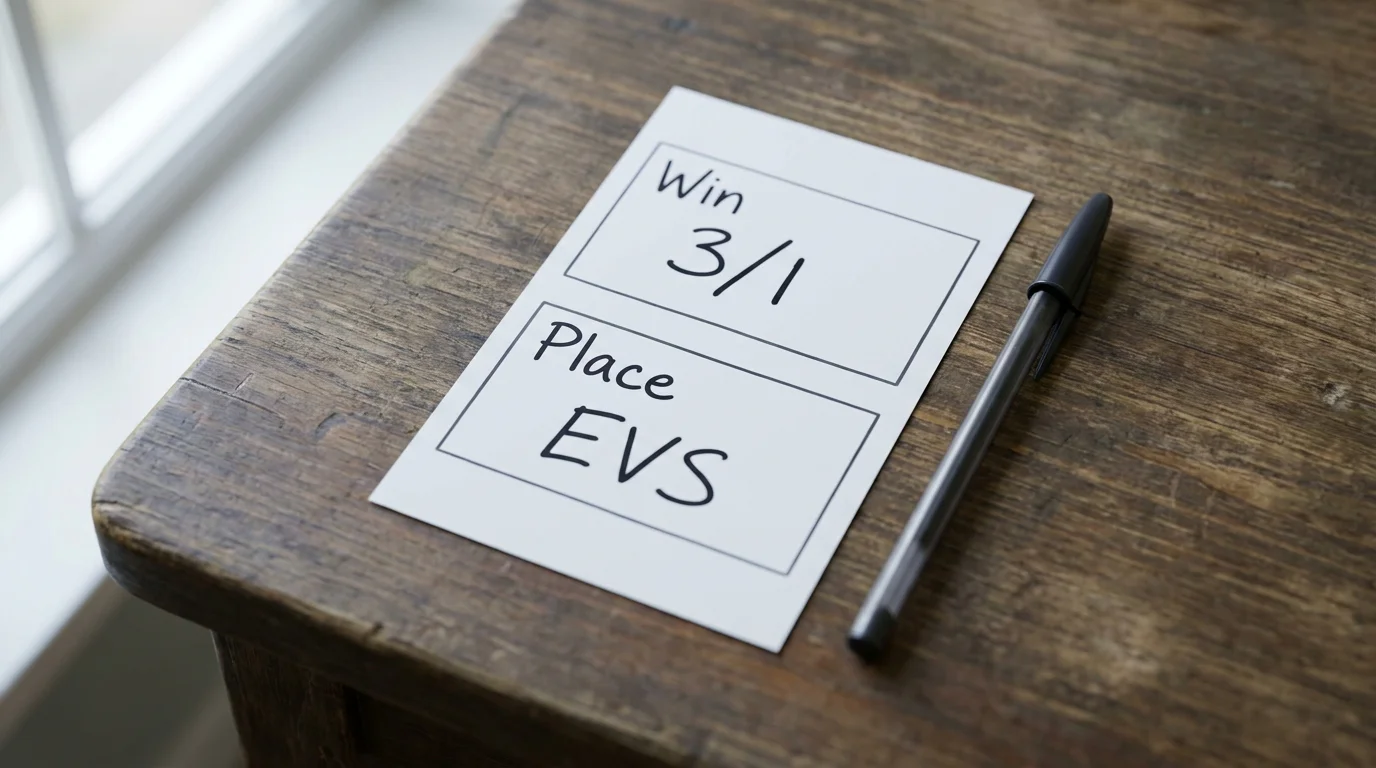
The place fraction and the number of paid places are the two variables that define the value of any each-way bet. In golf, the standard terms for most full-field events are 1/4 of the win odds for the first five places. So if your player is priced at 40/1 to win, the place part pays at 10/1 (40 divided by 4). Some bookmakers offer 1/5 of the odds for a wider range of places — say, the first eight — which looks generous on the surface but pays a smaller fraction per place. We’ll compare those two structures in detail shortly.
Here’s the anatomy laid out plainly. Suppose you back a player at 50/1, 10 pounds each-way, with terms of 1/4 odds for the first five places. Your total stake is 20 pounds. If the player wins: the win part returns 10 pounds multiplied by 50, plus your 10-pound stake back, giving you 510 pounds from the win leg. The place part returns 10 pounds multiplied by 12.5 (that’s 50 divided by 4), plus your 10-pound stake, giving you 135 pounds from the place leg. Total return: 645 pounds from a 20-pound outlay. If the player finishes fourth: the win part loses, costing you 10 pounds. The place part returns 135 pounds. Net profit: 115 pounds. If the player finishes seventh: both parts lose. You’re down 20 pounds.
The reason each-way betting suits golf so well is the mismatch between field size and outcome probability. A 156-player field means even the favourite rarely has more than a 10-12% implied chance of winning. The top five finishers collectively account for a much larger slice of the probability distribution, which means the place part of your bet hits far more often than the win part. Over hundreds of bets, that place-part income can be the difference between a losing record and a profitable one.
One detail that catches beginners: the place part uses fractional odds derived from the win price, not a separate market. There’s no independent “place odds” in each-way betting — the bookmaker applies the fraction mechanically. This matters because it means the value of the place part is entirely a function of the win price and the place terms. A player at 80/1 with 1/4 odds for five places has a place part paying 20/1. A player at 20/1 with the same terms has a place part paying 5/1. The longer the win price, the more generous the place part becomes in absolute terms — and the more the each-way structure tilts in your favour relative to a win-only bet.
That asymmetry is the engine of each-way value in golf. But it only works if you understand the terms and run the numbers before you click “place bet.” And that means knowing exactly what 1/4 and 1/5 mean in practice.
1/4 Odds vs 1/5 Odds: Which Pays More?
I spent an entire Saturday afternoon in early 2020 building a spreadsheet to answer this question definitively. At the time, two bookmakers were offering different each-way terms on the same PGA Tour event — one at 1/4 odds for five places, the other at 1/5 odds for eight places. I wanted to know which was better, and the answer turned out to be far more nuanced than “whichever pays more per place.”
Let’s set up the comparison with a concrete example. Take a player priced at 66/1. Under 1/4 terms for five places, the place part pays at 16.5/1 (66 divided by 4). A 10-pound place stake returns 175 pounds if the player finishes inside the top five. Under 1/5 terms for eight places, the place part pays at 13.2/1 (66 divided by 5). The same 10-pound place stake returns 142 pounds if the player finishes inside the top eight. Per-place, the 1/4 terms pay more. But the 1/5 terms cover three additional finishing positions.
The question then becomes: how often does a player at those odds finish sixth, seventh or eighth versus first through fifth? If the additional three places capture enough extra probability, the lower per-place payout is offset by the higher hit rate. For a 66/1 shot in a 156-player field, historical PGA Tour data suggests that roughly 8-10% of the time a player in that odds range finishes between sixth and eighth — positions that would miss under 1/4 terms but collect under 1/5. That’s meaningful probability.
Here’s the same logic in a table format. For our 66/1 player, 10 pounds each-way:
| Terms | Place fraction | Place odds | Paid places | Place return (if placing) |
|---|---|---|---|---|
| 1/4, 5 places | 1/4 | 16.5/1 | 1st-5th | 175 pounds |
| 1/5, 8 places | 1/5 | 13.2/1 | 1st-8th | 142 pounds |
With total prize money across the PGA Tour hitting 450 million dollars in the 2026 season, the depth of competition means more bunching around those sixth-to-eighth positions. Fields are deeper. The cut from fifth to eighth in scoring is often just a stroke or two. That clustering makes those extra three places under 1/5 terms more valuable than they might appear from the raw payout difference.
But — and this is the critical nuance — the advantage of 1/5 terms diminishes as the win price shortens. A player at 14/1 pays 3.5/1 on the place under 1/4 terms and 2.8/1 under 1/5 terms. The difference in place payout is smaller in absolute terms, while the player’s probability of finishing in the top five is already reasonably high. For shorter-priced players, 1/4 terms for five places tend to offer better expected value than 1/5 terms for eight places, because the extra positions don’t add enough probability to justify the lower fraction.
My rule of thumb after years of tracking this: for players priced 40/1 and above, 1/5 terms for eight places are usually preferable. For players between 16/1 and 33/1, 1/4 terms for five places tend to win. Below 16/1, the each-way value thins out considerably under either structure, and you’re often better off considering a straight top-five or top-ten market instead. These aren’t hard rules — they depend on field strength, course characteristics and the specific places on offer — but they’re a reliable starting framework that I still use every week when comparing terms across the each-way payout formula for a given tournament.
The worst mistake is assuming one structure is always superior. It isn’t. The answer changes with every player, every price and every set of terms. Run the numbers each time.
Step-by-Step Payout Calculations
Numbers don’t lie, but they do hide if you don’t chase them. I’ve lost count of the times punters have told me they “roughly know” what their each-way bet would return. Roughly isn’t good enough. A 10-pound each-way bet at 80/1 with 1/4 terms returns a very different amount from the same bet at 80/1 with 1/5 terms, and if you can’t calculate both in your head (or on your phone), you’re flying blind. Let me walk through three worked examples that cover the scenarios you’ll encounter most often.
Example 1: Standard each-way, player wins
Player: 40/1 to win. Stake: 5 pounds each-way (10 pounds total). Terms: 1/4 odds, first five places. The player wins the tournament.
Win part: 5 pounds at 40/1 = 200 pounds profit + 5 pounds stake returned = 205 pounds. Place part: the place odds are 40 divided by 4 = 10/1. So 5 pounds at 10/1 = 50 pounds profit + 5 pounds stake returned = 55 pounds. Total return: 205 + 55 = 260 pounds. Total profit: 260 minus 10 (total stake) = 250 pounds.
Example 2: Standard each-way, player places but doesn’t win
Same bet: 5 pounds each-way on a 40/1 shot, 1/4 odds for five places. The player finishes fourth.
Win part: loses. You forfeit your 5-pound win stake. Place part: 5 pounds at 10/1 = 50 pounds profit + 5 pounds stake returned = 55 pounds. Total return: 55 pounds. Total profit: 55 minus 10 (total stake) = 45 pounds. Even though your player didn’t win, you’ve more than quadrupled your outlay. This is the scenario that makes each-way betting so appealing in golf — a top-five finish on a 40/1 shot still delivers a handsome return.
Example 3: 1/5 odds with extended places
Player: 66/1. Stake: 10 pounds each-way (20 pounds total). Terms: 1/5 odds, first eight places. The player finishes seventh.
Win part: loses. Place part: the place odds are 66 divided by 5 = 13.2/1. So 10 pounds at 13.2/1 = 132 pounds profit + 10 pounds stake returned = 142 pounds. Total return: 142 pounds. Total profit: 142 minus 20 = 122 pounds.
Now compare that to what would have happened under 1/4 terms for five places. A seventh-place finish is outside the top five, so both parts lose and you’re down 20 pounds. The difference between +122 and -20 is 142 pounds — all because of the terms. Scottie Scheffler pocketed 3.1 million dollars for winning The Open Championship in 2025, but the real money in each-way betting is often in the place part, not the win. Understanding terms is understanding where your profit actually comes from.
The general formula
For any each-way bet, the calculation follows this structure:
Win return = (stake x win odds) + stake. Place return = (stake x (win odds / place fraction)) + stake. Total return if player wins = win return + place return. Total return if player places only = place return. Profit = total return minus total stake (which is 2 x unit stake).
When working with decimal odds instead of fractional, the conversion is straightforward. Decimal odds of 41.0 are equivalent to 40/1 fractional. The place part in decimal is calculated as: ((decimal odds – 1) / place fraction) + 1. For 41.0 decimal at 1/4 terms: ((41 – 1) / 4) + 1 = 11.0 decimal place odds. Your place return is then stake multiplied by 11.0.
I’d encourage you to practise these calculations until they become automatic. Pick a random player from this week’s betting market, note the odds and the terms, and work out the return for a win, a place and a miss before you even consider whether the bet has value. That mechanical discipline is what separates punters who understand each-way from those who just think they do.

Extended Places and Enhanced Each-Way Offers
Every major championship week, my inbox fills with the same question: “Is this extended places offer actually good?” The answer is almost always yes — but not for the reasons most punters think, and not always by as much as the headline suggests.
Extended places are promotional offers where a bookmaker increases the number of paid positions beyond the standard terms. Instead of five places at 1/4 odds, you might see eight places at 1/4, or even ten places at 1/5. These offers appear most frequently around the four majors and high-profile events like the Players Championship, where bookmaker competition for new sign-ups is fiercest. The UK gambling industry generated 11.5 billion pounds in gross gaming yield between April 2023 and March 2024, and golf’s biggest weeks are prime territory for customer acquisition.
The genuine value in extended places comes from the additional positions, not from any change in the fraction. If a standard offer is 1/4 for five places and the enhanced offer is 1/4 for eight places, you’re getting three extra finishing positions at the same payout rate per place. That’s unambiguous additional value. But if the enhanced offer is 1/5 for eight places versus 1/4 for five, you need to weigh the reduced fraction against the extra coverage — and as we explored in the previous section, the answer depends on the player’s price.
Here’s where I see punters make consistent errors with extended places. First, they assume the offer is automatically better than the standard terms without checking the fraction. An “enhanced” offer of 1/5 for six places can actually be worse than the standard 1/4 for five places for shorter-priced selections. Second, they treat extended places as a reason to bet rather than a filter for bets they’d already identified as having value. The offer should improve the expected return on a bet you were going to make anyway — it shouldn’t be the sole reason for the bet.
Third — and this is the subtlest trap — extended places can shift the optimal selection profile. Under standard five-place terms, you might favour a player who’s a genuine contender for the win with top-five upside. Under eight-place terms, a consistent performer who grinds out top-ten finishes but rarely threatens the lead becomes more attractive. I’ve had profitable major weeks by specifically targeting “place machines” — players in the 50/1 to 80/1 range who have a strong record of top-ten finishes at that venue — when extended places were on offer.
One more thing worth noting: enhanced each-way offers sometimes come with restrictions. The bet might need to be a minimum stake, or it might only apply to pre-tournament singles (not in-play or accumulators). Read the terms before placing. The promotional headline is designed to get you through the door, but the conditions determine whether the offer actually changes the maths in your favour.
When Each-Way Meets a Dead Heat
The most expensive surprise in golf betting isn’t a withdrawal or a disqualification — it’s a dead heat at the edge of the place positions. I once backed a player each-way at 50/1 with five places paid. He finished in a four-way tie for fourth. I was expecting a full place payout. What I got was a fraction of one. That’s the dead heat rule in action, and it catches experienced punters just as often as newcomers.
A dead heat occurs when two or more players tie for a position that falls at the boundary of the paid places. In each-way betting, it affects the place part when the tied position spans both inside and outside the paying range. The rule is simple in principle: your stake is divided by the number of players who could fill the available positions, and you’re paid out on that reduced stake at full place odds.
Let me walk through a concrete scenario. You’ve backed a player at 50/1, 10 pounds each-way, with terms of 1/4 odds for five places. Three players tie for fourth place. There are two available “places” remaining (fourth and fifth) but three players sharing them. The dead heat fraction is 2/3. Your place stake is reduced from 10 pounds to 6.67 pounds (10 x 2/3). The place odds remain 12.5/1 (50/4). So your place return is 6.67 x 12.5 = 83.33 pounds profit, plus 6.67 pounds stake returned = 90 pounds. Without the dead heat, the return would have been 135 pounds. That’s a 45-pound difference from a rule that most punters can’t explain until it hits them.
It gets worse with larger ties. Four players tie for fifth when five places are paid? Only one position is available for four players. The fraction is 1/4. Your 10-pound place stake becomes 2.50 pounds, and the return shrinks accordingly. Five players tie for third with five places paid? Three positions available for five players, fraction 3/5. The arithmetic is always the same: available positions divided by number of tied players, applied to your stake.
Dead heats are more common in golf than in most other sports because scoring ties happen constantly. After 72 holes, it’s normal for three, four or even five players to share the same total. Play-offs settle the winner, but they don’t affect place betting — positions below the play-off are settled on the tied score. If you’re betting each-way at prices where the place part carries most of your expected return, dead heat risk is a genuine drag on long-term profitability.
My approach is to factor dead heat probability into every each-way assessment, particularly for bets on players in the 40/1 to 100/1 range where the place part dominates the expected return. I don’t avoid bets because of dead heat risk — that would eliminate too many opportunities — but I do adjust my expectations downward when the dead heat rules are likely to apply, especially in major championships where deep fields produce more ties at the place boundary.
Expected Value of Each-Way vs Win-Only
Here’s the question that sits at the heart of every each-way decision: does splitting your stake into win and place parts generate more expected value than putting the full amount on the win? I’ve run this analysis on over 3,000 golf bets across nine years of records, and the answer is reliably conditional on price.
Expected value — EV — is the average return you’d get if you placed the same bet thousands of times. A positive EV bet is one where the expected return exceeds the stake. For each-way, you’re calculating the EV of two linked bets: the win part and the place part. The total EV is the sum of both. For a win-only bet at the same total stake, you calculate a single EV at the full win odds.
At short prices — anything under 20/1 — win-only bets almost always have higher EV than each-way, assuming you’ve identified genuine value in the win price. The reason is mechanical: the place fraction compresses the odds, and for shorter-priced players the probability of placing but not winning (the range where only the place part pays) is relatively narrow. You’re diluting your exposure to the more profitable outcome by splitting the stake. A 10/1 shot with 1/4 terms gives you place odds of 2.5/1 — barely worth the diversion of half your stake.
Between 20/1 and 40/1, the picture is genuinely mixed. This is the range where each-way can outperform win-only if the place terms are strong and the player’s profile suits top-five finishes. A classic “place machine” — someone who consistently contends without winning — generates positive place-part EV that can lift the combined each-way EV above what a win-only bet would deliver. But this depends heavily on your assessment of the player’s finishing distribution, not just their win probability.
Above 40/1, each-way is almost always the superior structure for profitable betting. The win probability is low enough that the expected return from the win part alone rarely justifies the full stake. The place part, however, sits at odds that still offer meaningful returns (10/1 and above under 1/4 terms), and the probability of a top-five finish for a player in this price range — while still low in absolute terms — is substantially higher than the win probability. Scott Warfield, the PGA Tour’s Vice President of Gaming, has talked about the “stickiness” of golf betting audiences — once people engage, they stay. Each-way betting at longer prices is a big part of that stickiness, because it delivers small wins frequently enough to keep punters in the game while preserving exposure to the life-changing payout if the player goes on to lift the trophy.
The EV framework I use works like this: I estimate a player’s probability of winning and their probability of finishing in the places separately. I multiply each probability by its respective payout and subtract the respective stake. If the combined EV is positive, the each-way bet has value. If only the win EV is positive, I bet win-only at double the unit stake. If only the place EV is positive — which happens more often than you’d think at longer prices — I look for a standalone top-five or top-ten market instead, since those remove the drag of the losing win part.
This separation is the key insight. Each-way isn’t automatically better or worse than win-only. It’s a different distribution of risk and reward, and the right choice depends on where the value sits — in the win, in the place, or in both. Treat each part as its own bet, assess each on its own merits, and the decision makes itself.

Each-Way Golf Betting FAQ
Are each-way terms the same at every bookmaker for the same golf event?
No. Each-way terms vary between bookmakers and even between events at the same bookmaker. One operator might offer 1/4 odds for five places on a standard PGA Tour event while another offers 1/5 odds for eight places. Major championships often have more generous terms across the board, but the specifics still differ. Always check the terms before placing — the difference between 1/4 and 1/5 on a 66/1 shot is roughly 33 pounds on a 10-pound each-way bet, which adds up fast over a season.
Can I place an each-way bet in-play during a golf tournament?
Some UK-licensed bookmakers do offer each-way in-play betting on golf, though the terms and availability are more limited than pre-tournament. The number of paid places may shrink as the field is cut after round two, and the place fraction can change. In-play each-way is most commonly available during rounds three and four when the field is already reduced. Check your bookmaker’s in-play terms carefully — they won’t necessarily match the pre-tournament offer.
How do extended each-way places change the expected payout?
Extended places increase the number of finishing positions that trigger the place part of your bet. If standard terms are five places and the extended offer is eight places, you have three additional positions that would generate a return. The payout per place stays the same if the fraction is unchanged (e.g. 1/4 for eight places instead of five). If the fraction is reduced to accommodate the extra places (e.g. 1/5 for eight instead of 1/4 for five), the per-place payout drops but the broader coverage can still improve overall expected value, especially on longer-priced selections.
What is the minimum number of runners required for each-way golf bets?
Most UK bookmakers require a minimum field size for each-way betting to apply. The typical threshold is eight or more runners, though some set it at five. In golf, this rarely matters for full-field events with 156 players, but it can be relevant for smaller invitation events or the later stages of match-play tournaments where the field narrows. If the minimum isn’t met, bets are settled as win-only regardless of whether you selected each-way.
