
 Available in US
Content
Know Your Payout Before You Place the Bet
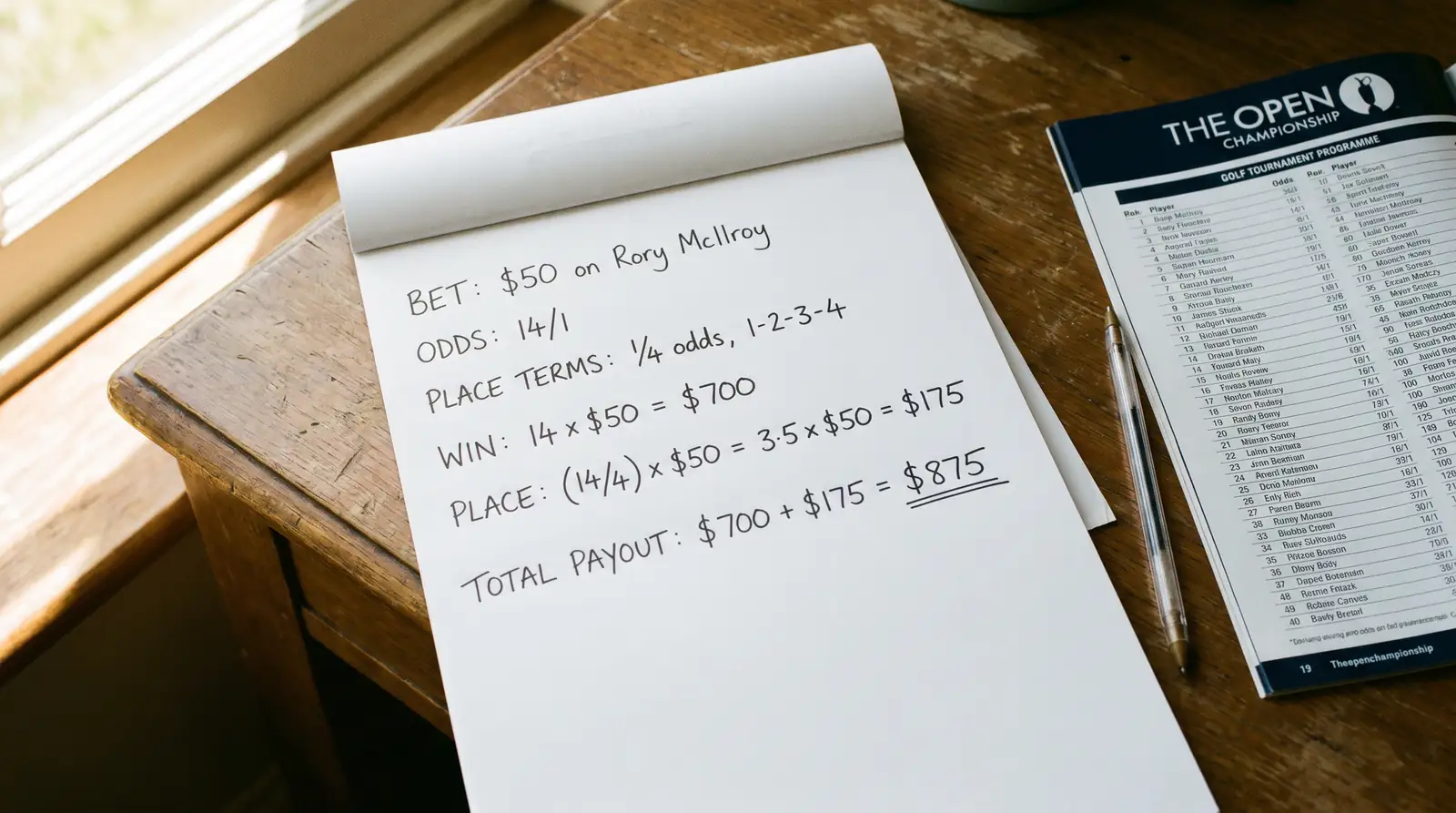
I cannot count the number of times I have seen punters on betting forums ask “why was my payout so low?” after an each-way golf bet settles. The answer is always the same: they did not calculate the return before placing the bet. Each-way golf betting has moving parts — the win portion, the place portion, the place terms, the number of places paid, and the potential for dead heats — and understanding how all those parts fit together is the difference between an informed punt and a confused one.
The UK gambling industry generated total gross gaming yield of GBP 11.5 billion in the year to March 2024, and a meaningful slice of golf-specific volume sits in each-way markets. These are among the most popular bet types for UK punters, precisely because they offer a payout for finishing in the places even when the win part loses. But the popularity of the bet does not mean it is well understood. The formula is straightforward once you see it laid out — and once you learn it, you will never need to rely on an online calculator again.
The Each-Way Payout Formula Explained
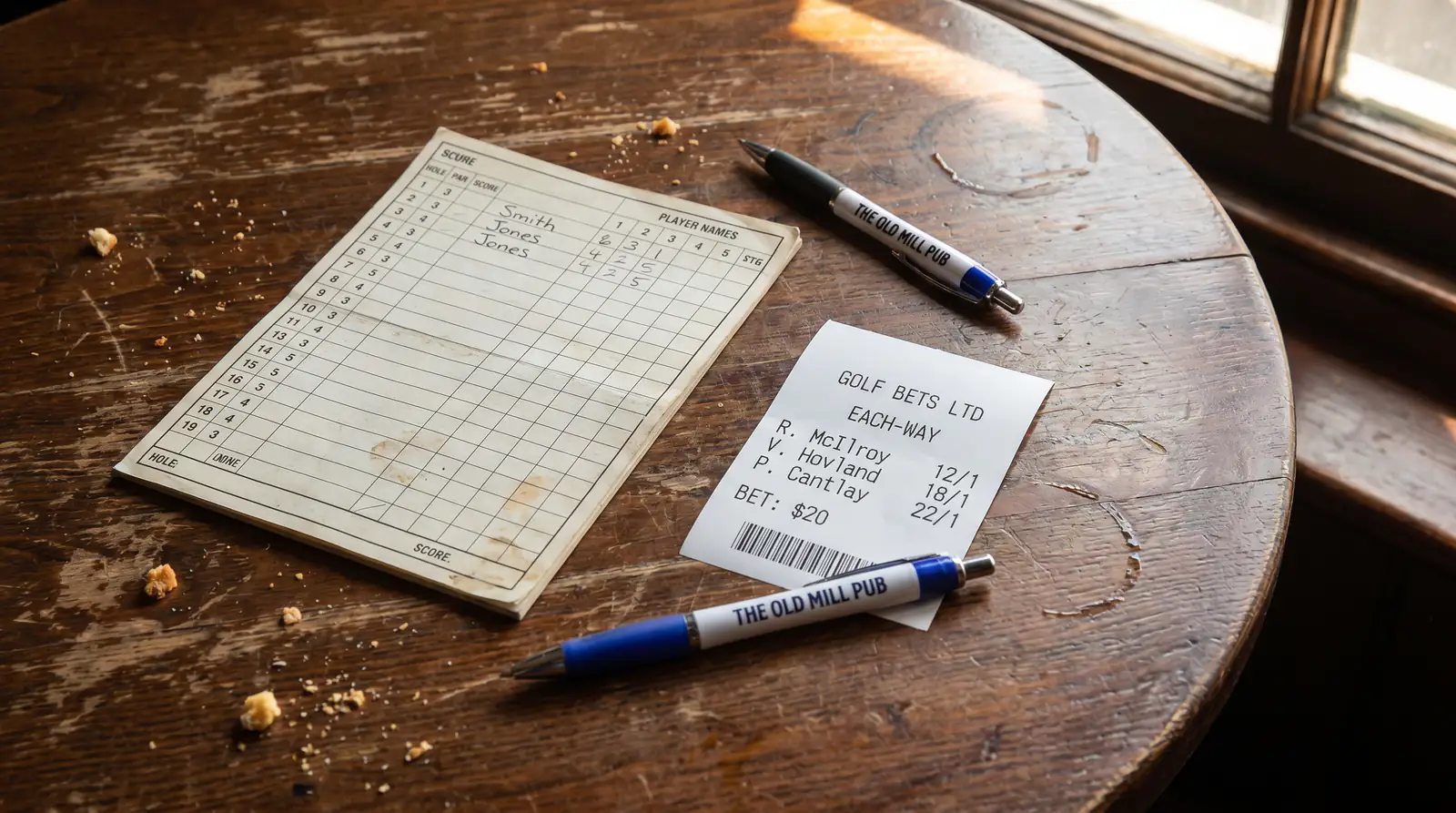
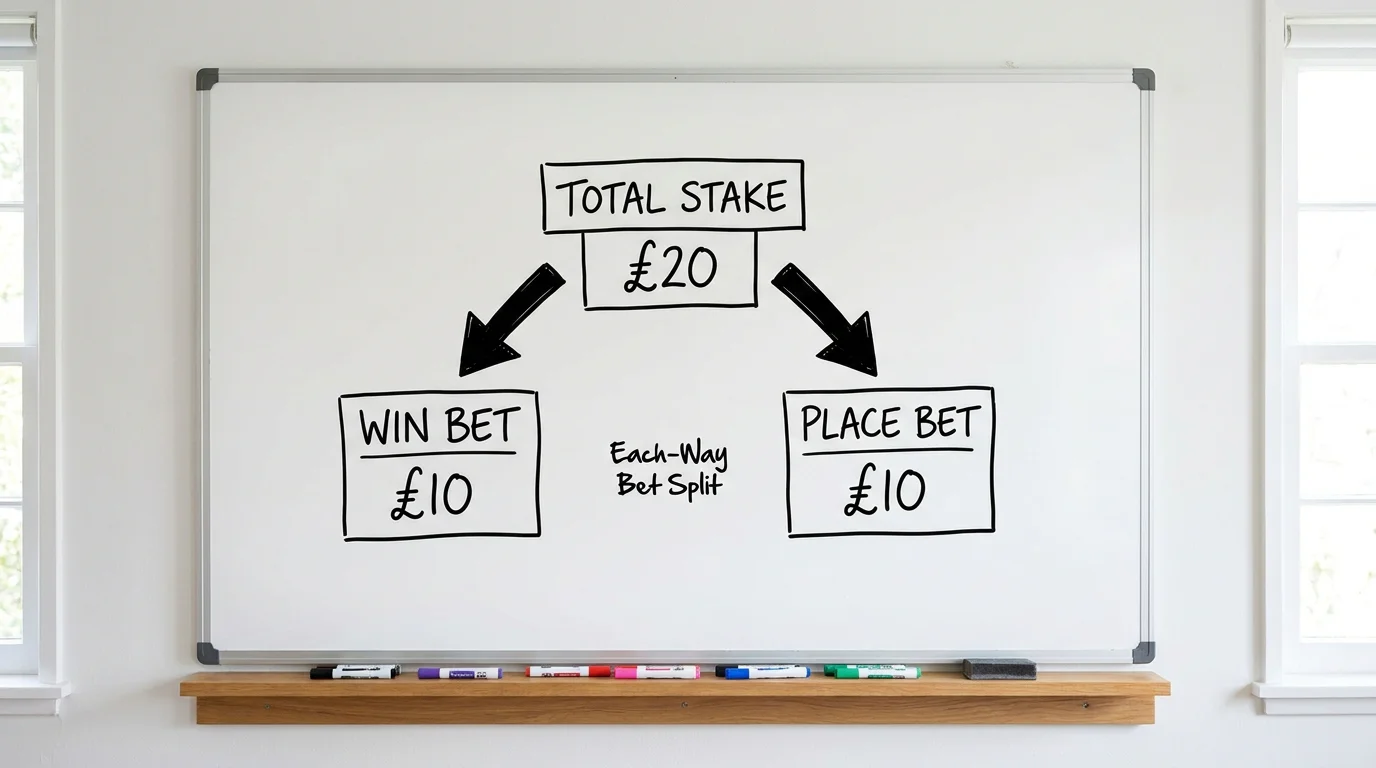
An each-way bet is two bets in one: a win bet and a place bet. Your total stake is doubled because you are placing two separate wagers of equal size. If you “put GBP 10 each way,” your total outlay is GBP 20 — GBP 10 on the win and GBP 10 on the place.
The win part settles at the full advertised odds. If your player wins the tournament at 40/1, the win part returns GBP 410 (GBP 400 profit plus GBP 10 stake).
The place part settles at a fraction of the full odds, determined by the bookmaker’s place terms. The two most common terms in golf are 1/4 the odds and 1/5 the odds. At 1/4 of 40/1, the place odds are 10/1. At 1/5 of 40/1, the place odds are 8/1. The number of places paid (typically five, six, or eight in golf) determines whether your player qualifies for the place payout.
The formula for total return when the player wins: (stake x full odds + stake) + (stake x place odds + stake). The formula when the player places but does not win: stake x place odds + stake. And when the player finishes outside the paid places: zero — both parts lose. For a thorough guide to the mechanics and strategy behind each-way betting, the each-way golf betting guide covers everything from basic terms to expected value comparisons.
Worked Example: 1/4 Odds, Five Places
Here is a concrete scenario I worked through last season. Player A is priced at 33/1 for the outright winner market. The bookmaker offers each-way terms of 1/4 the odds for five places. I place GBP 10 each way — GBP 20 total stake.
Step one: calculate the place odds. 1/4 of 33/1 = 33/4 = 8.25/1. In practice, most bookmakers round to 8/1 for simplicity, but some calculate the fractional amount precisely. Check the small print — the difference matters on larger stakes.
Step two: if Player A wins. Win return: GBP 10 x 33 + GBP 10 = GBP 340 + GBP 10 = GBP 350. Place return: GBP 10 x 8.25 + GBP 10 = GBP 82.50 + GBP 10 = GBP 92.50. Total return: GBP 350 + GBP 92.50 = GBP 442.50. Total profit: GBP 442.50 – GBP 20 (total stake) = GBP 422.50.
Step three: if Player A finishes 4th (within the five paid places, but does not win). Win part: loses. GBP 10 gone. Place return: GBP 10 x 8.25 + GBP 10 = GBP 92.50. Total return: GBP 92.50. Total profit: GBP 92.50 – GBP 20 = GBP 72.50.
Step four: if Player A finishes 8th (outside the five paid places). Both parts lose. Total return: GBP 0. Total loss: GBP 20. The PGA Tour’s 2026 total prize pool of $450 million means every Signature Event features at least $20 million in prize money — but the each-way maths stays the same whether the purse is $2 million or $20 million. The formula is universal.
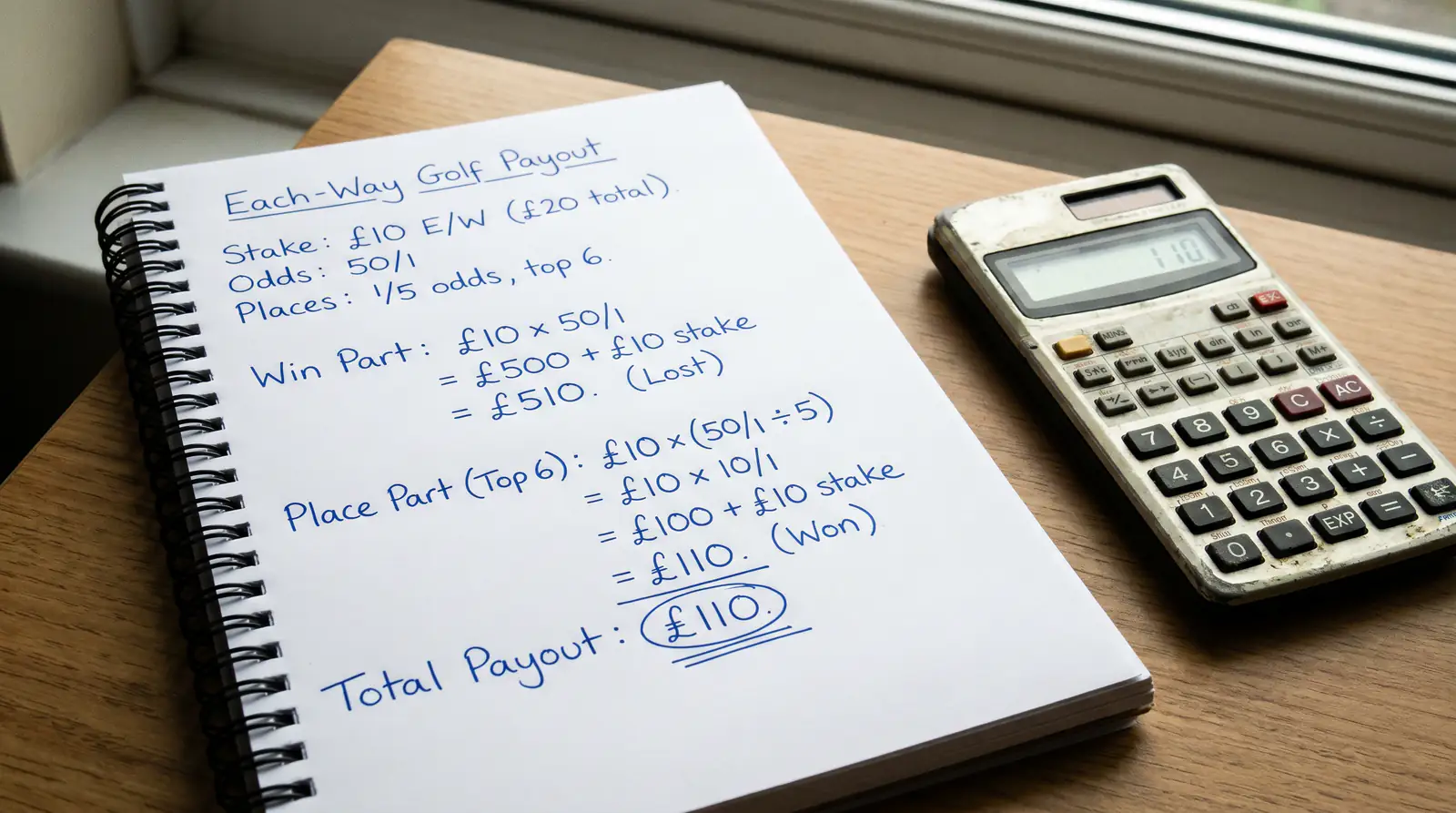
Worked Example: 1/5 Odds, Eight Places
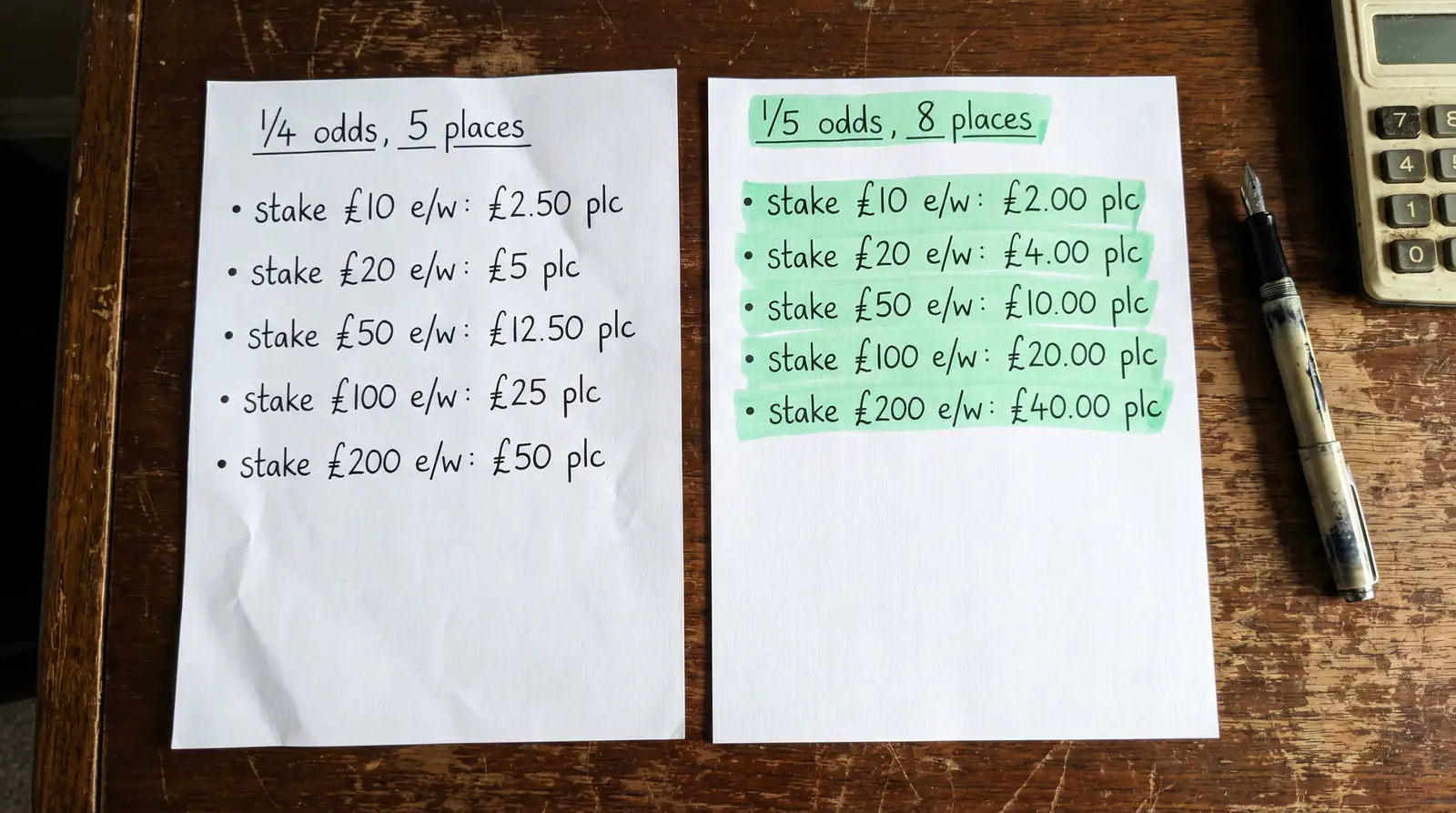
Same player, same GBP 10 each way, but now the bookmaker offers 1/5 the odds for eight places — terms commonly seen at major championships and enhanced each-way promotions.
Place odds: 1/5 of 33/1 = 33/5 = 6.6/1.
If Player A wins. Win return: GBP 350 (same as before). Place return: GBP 10 x 6.6 + GBP 10 = GBP 66 + GBP 10 = GBP 76. Total return: GBP 350 + GBP 76 = GBP 426. Total profit: GBP 406.
Notice: the total return on a win is slightly lower under 1/5 terms (GBP 426) than under 1/4 terms (GBP 442.50), because the place fraction is smaller. But the trade-off is that eight places pay out instead of five. If Player A finishes 7th, the 1/5 terms deliver a GBP 76 return (GBP 56 profit), while the 1/4 terms deliver nothing because the player finished outside five places.
If Player A places (finishes 2nd through 8th). Place return: GBP 76. Total profit: GBP 76 – GBP 20 = GBP 56. Grainne Hurst, CEO of the Betting and Gaming Council, has spoken about the industry’s role in the wider economy — “BGC members welcomed the recent growth figures.” That growth is partly fuelled by each-way golf betting, where the combination of long outright odds and place terms gives punters a two-chance bet that no other sport replicates at the same scale.
The decision between 1/4 and 1/5 terms depends on your view of the player’s finishing range. If you believe the player is a genuine top-five contender, 1/4 terms at five places pay more when the place part lands. If you see the player as a top-ten contender who might not crack the top five, 1/5 terms at eight places give you wider coverage at a slightly lower per-place payout. I make this call on a bet-by-bet basis, and I always calculate both scenarios before choosing the bookmaker.
Adjusting the Calculation for a Dead Heat
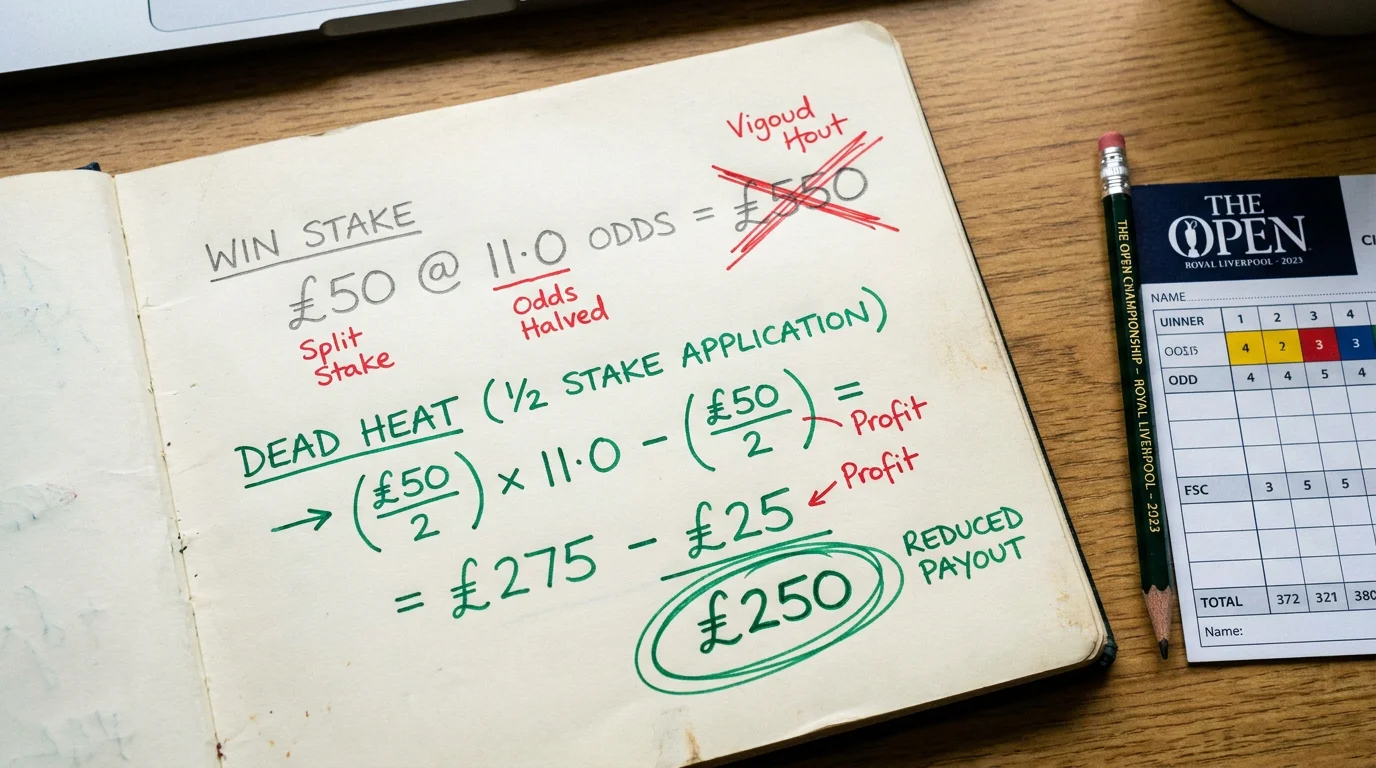
Dead heats add one more step to the formula. When your player ties with one or more others for a paying place, the payout is reduced proportionally.
Suppose Player A finishes in a two-way tie for fifth, with five places paid. One paying position remains (fifth place), shared between two players. The dead heat fraction is 1/2. Apply it to the full place return: GBP 92.50 x 1/2 = GBP 46.25. That is the total you receive from the place part — GBP 26.25 profit on a GBP 20 total outlay.
A three-way tie for fifth would produce a fraction of 1/3. One-third of GBP 92.50 = GBP 30.83. Still profitable, but notably less than the full place return. I always run the dead heat scenario before placing an each-way bet in a tight market, because knowing the worst-case place return helps me decide whether the bet is worth the outlay. If a dead heat reduces the place profit to near zero, the bet’s appeal rests entirely on the win part — and that changes the value assessment entirely.
Each-Way Calculator FAQ
How do I calculate an each-way return when the place odds are 1/5 instead of 1/4?
Divide the full fractional odds by 5 to get the place odds. At 40/1 with 1/5 terms, the place odds are 8/1. Multiply your place stake by the place odds and add the stake back to get the place return. At GBP 10 each way: place return = GBP 10 x 8 + GBP 10 = GBP 90. If the player wins, add the full-odds win return to the place return for the total.
Does the each-way payout formula change if there is a dead heat for a place?
The formula stays the same, but a dead heat fraction is applied to the final place return. Count how many paying positions remain at the tied rank, divide by the number of tied players, and multiply the full place return by that fraction. In a two-way tie for the last paying position: 1/2 of the place return. Three-way tie: 1/3. The win part is unaffected unless the dead heat involves the tournament winner, which is resolved by a play-off in professional golf.
