
 Available in US
Content

The Number Behind Every Golf Betting Odd
For years, I looked at odds and saw prices. A player at 25/1 meant I could win 25 times my stake. That was the extent of my analysis. Then I learned to look at odds and see probabilities instead, and everything changed. Every price a bookmaker quotes encodes a probability — an estimate of how likely the event is to occur. Decoding that probability is the first step toward finding value, because once you know what the bookmaker thinks, you can decide whether you agree.
The US golf betting market was estimated at $3.5 billion in 2023, and the UK market — while not separately broken out — represents a significant share of global golf wagering. The total UK gambling industry generated gross gaming yield of GBP 11.5 billion in the year to March 2024. Within that volume, every golf bet placed carries an implied probability derived from the odds. Understanding that derivation turns odds from arbitrary numbers into analytical tools.
The Conversion Formula for Fractional and Decimal Odds
The maths is not complicated, but it needs to become second nature. I run these conversions in my head now — but it took a few weeks of practice before they felt automatic.
For decimal odds, the formula is: implied probability = 1 / decimal odds x 100. If a player is priced at 21.0 (which is 20/1 in fractional), the implied probability is 1 / 21.0 x 100 = 4.76%. The bookmaker is saying this player has roughly a one-in-21 chance of winning.
For fractional odds, the formula is: implied probability = denominator / (numerator + denominator) x 100. At 20/1, that is 1 / (20 + 1) x 100 = 4.76%. Same result, different route. At 5/2, the calculation is 2 / (5 + 2) x 100 = 28.57%. The player has an implied chance of just under 29%.
A few more examples to build fluency. A player at 8/1 (decimal 9.0): implied probability is 1/9 x 100 = 11.11%. A player at 33/1 (decimal 34.0): implied probability is 1/34 x 100 = 2.94%. A player at 4/7 (decimal 1.57): implied probability is 7/11 x 100 = 63.64%. That last one is the kind of price you see on a heavy matchup favourite.
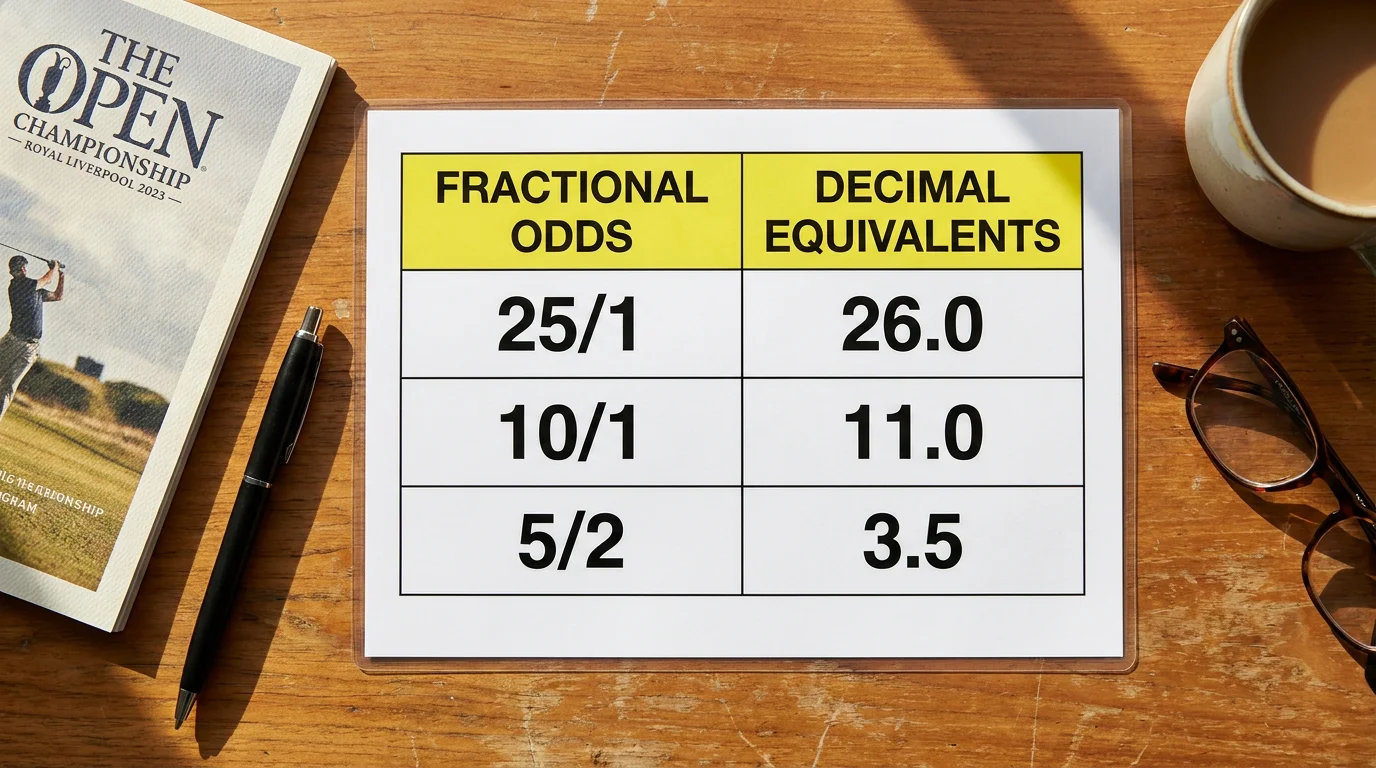
The critical point: implied probability is not true probability. It includes the bookmaker’s margin. A player with a genuine 5% chance of winning might be priced at odds that imply 4.5% or 4%. The gap is the bookmaker’s edge, and finding it requires stripping out the margin — which brings us to the overround.
Calculating the Overround in a 156-Player Field
The overround is the total of all implied probabilities in a market. In a perfectly fair book with no margin, the implied probabilities of every runner would sum to exactly 100%. In reality, they always sum to more — and in golf, the excess is significant.
To calculate the overround, convert every player’s odds to an implied probability and add them all together. If the sum is 135%, the overround is 35%. That 35% is the bookmaker’s built-in margin, spread across the entire field. The margin on any individual player is a fraction of the total overround, but it exists on every price.
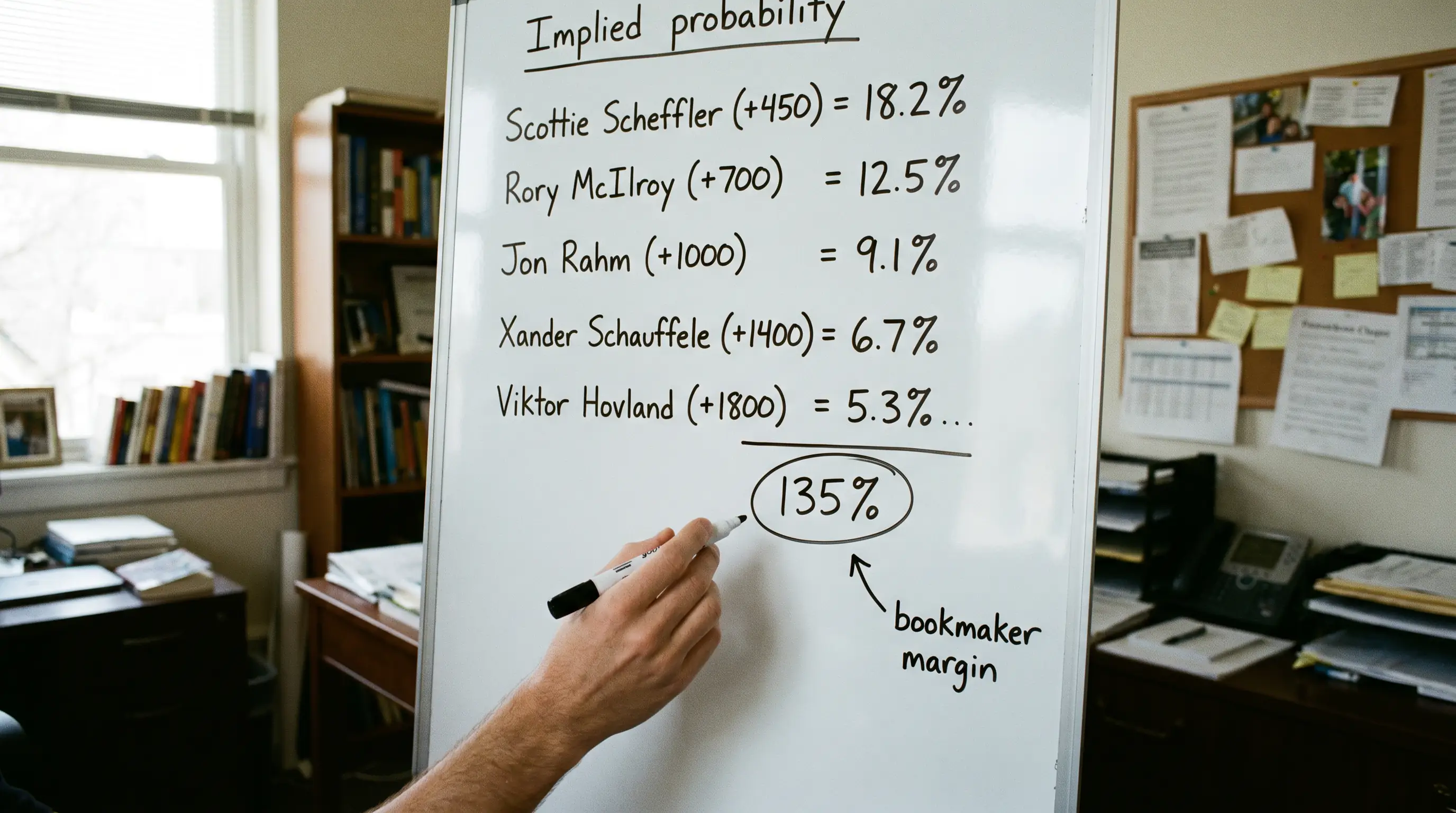
Golf outright markets typically carry overrounds between 120% and 145%, depending on the bookmaker and the event. Majors, which attract more betting volume, tend to have tighter overrounds (closer to 120%) because competitive pressure among bookmakers forces prices up. A mid-season PGA Tour event with less public interest may have overrounds pushing toward 140% or beyond.

Compare that to a football match with two or three outcomes and an overround of 103–108%, and you see the challenge. Golf’s overround is structurally higher because there are 156 possible outcomes, and each one carries a slice of margin. For a full guide on how these margins affect your strategy for reading and comparing golf prices, the golf betting odds overview covers the practical implications in detail.
Deriving Fair Odds and Spotting the Gap
Once you know the overround, you can strip it out to estimate “fair” odds — the price each player would be if the bookmaker took zero margin.
The simplest method: divide each player’s implied probability by the total overround (expressed as a decimal). If a player has an implied probability of 5% and the total overround is 130%, the fair probability is 5% / 1.30 = 3.85%. The fair decimal odds are 1 / 0.0385 = 26.0 (or roughly 25/1). The bookmaker priced them at 20/1 — the difference between 25/1 and 20/1 is the margin on that specific player.
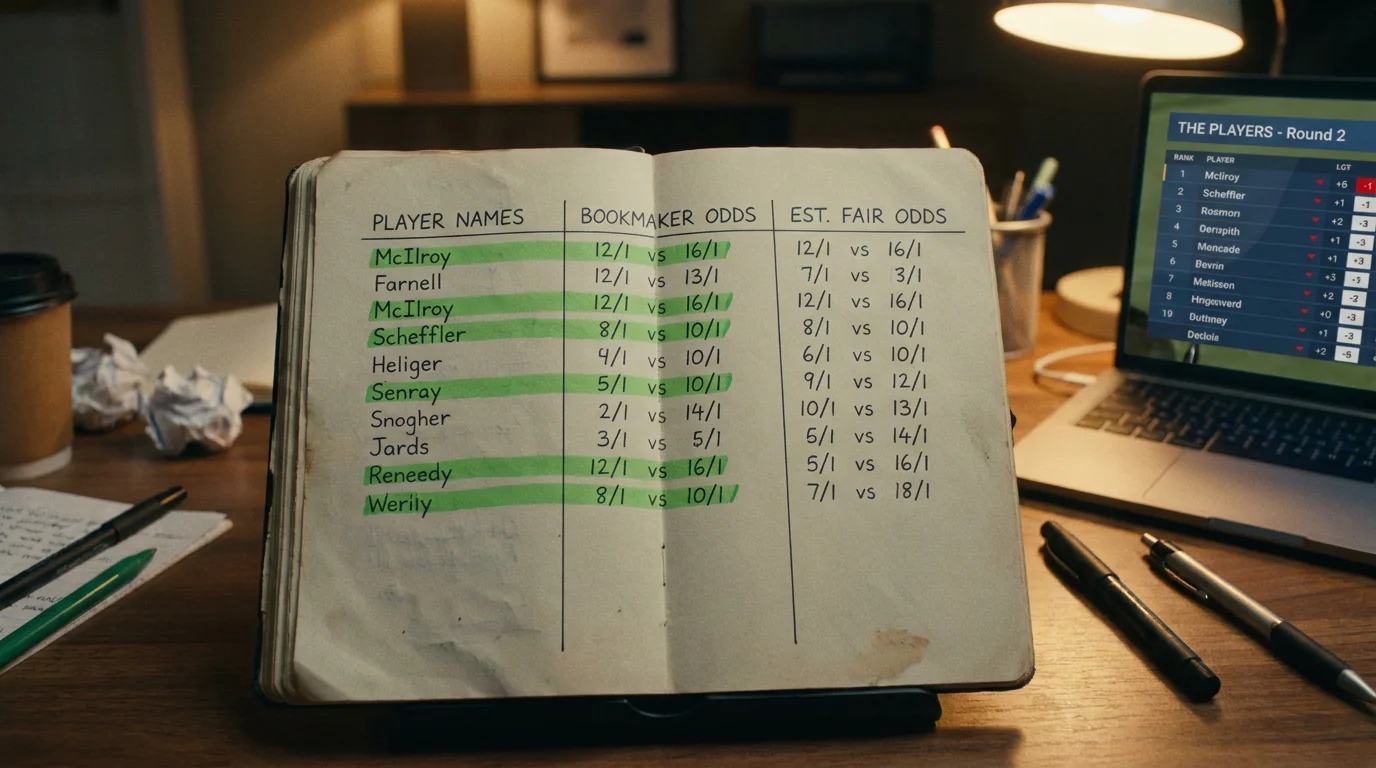
Now here is where it gets actionable. If my own analysis gives a player a 6% probability of winning and the bookmaker’s fair probability is 3.85%, I have a potential value bet. The market says 3.85%; I say 6%. If I am right, backing the player at 20/1 (implied 5%) has positive expected value, because even at the margin-included price, my estimated probability exceeds the implied one.
The discipline is in the estimation. My probability for any player is based on course fit (Strokes Gained alignment), recent form (last eight events), historical results at the venue, and field strength. I assign rough probabilities to my shortlisted players and compare them to the market. If my number is at least 30% higher than the bookmaker’s implied probability — say, I estimate 6% and the market implies 4.5% or less — I consider it a bet. Below that threshold, the edge is too thin to survive the natural noise of a 156-player field.
A practical tool I use weekly: a three-column spreadsheet. Column A lists shortlisted players. Column B shows the bookmaker’s implied probability. Column C shows my estimated probability. I only bet when Column C exceeds Column B by a meaningful margin. Over a season, this filter keeps me out of marginal bets and concentrates my capital on the selections where my analysis disagrees most strongly with the market. That disagreement — when it is rooted in data rather than hope — is where profit lives.

Implied Probability FAQ
What is a typical overround percentage for a PGA Tour outright market?
Most PGA Tour outright markets carry an overround between 120% and 145%. Major championships and high-profile events tend to sit at the lower end (120–130%) because competitive pressure among bookmakers tightens the prices. Lower-profile events with less betting volume may push the overround above 135%. Checking the overround before betting tells you how much margin you are paying.
How do I convert fractional golf odds to implied probability in one step?
Divide the denominator (the second number) by the sum of the numerator and denominator, then multiply by 100. For 25/1: 1 / (25 + 1) x 100 = 3.85%. For 9/2: 2 / (9 + 2) x 100 = 18.18%. This gives you the implied probability including the bookmaker’s margin. To find the true probability, you need to adjust for the overround.
