
 Available in US
Content
Value Is the Only Edge That Lasts
For the first three years of my golf betting career, I backed players I thought would win. That sounds logical until you realise the distinction between “will win” and “is priced below their true probability.” The shift from outcome-focused thinking to value-focused thinking was the single most important change I ever made. I started losing fewer bets? No — my strike rate barely moved. I started making more money because the bets I placed had positive expected value, and over hundreds of wagers, the maths did the heavy lifting.
The PGA Tour has seen 20% annual handle growth in 2025, with betting volume surging 50% during the FedEx Cup Playoffs alone. That influx of money creates both efficiency and opportunity. More money means bookmaker prices are sharper on high-profile players, but it also means casual bettors are pushing certain prices out of alignment — typically shortening favourites and overlooking mid-field players whose true probabilities exceed their market prices.
Building Your Own Probability Estimates
Value betting starts with one uncomfortable requirement: you need to form your own view of a player’s win probability, independent of the bookmaker’s price. If you only look at the odds after forming your opinion, you are assessing value. If you look at the odds first, you are anchoring to the market — and the market already includes the bookmaker’s margin.
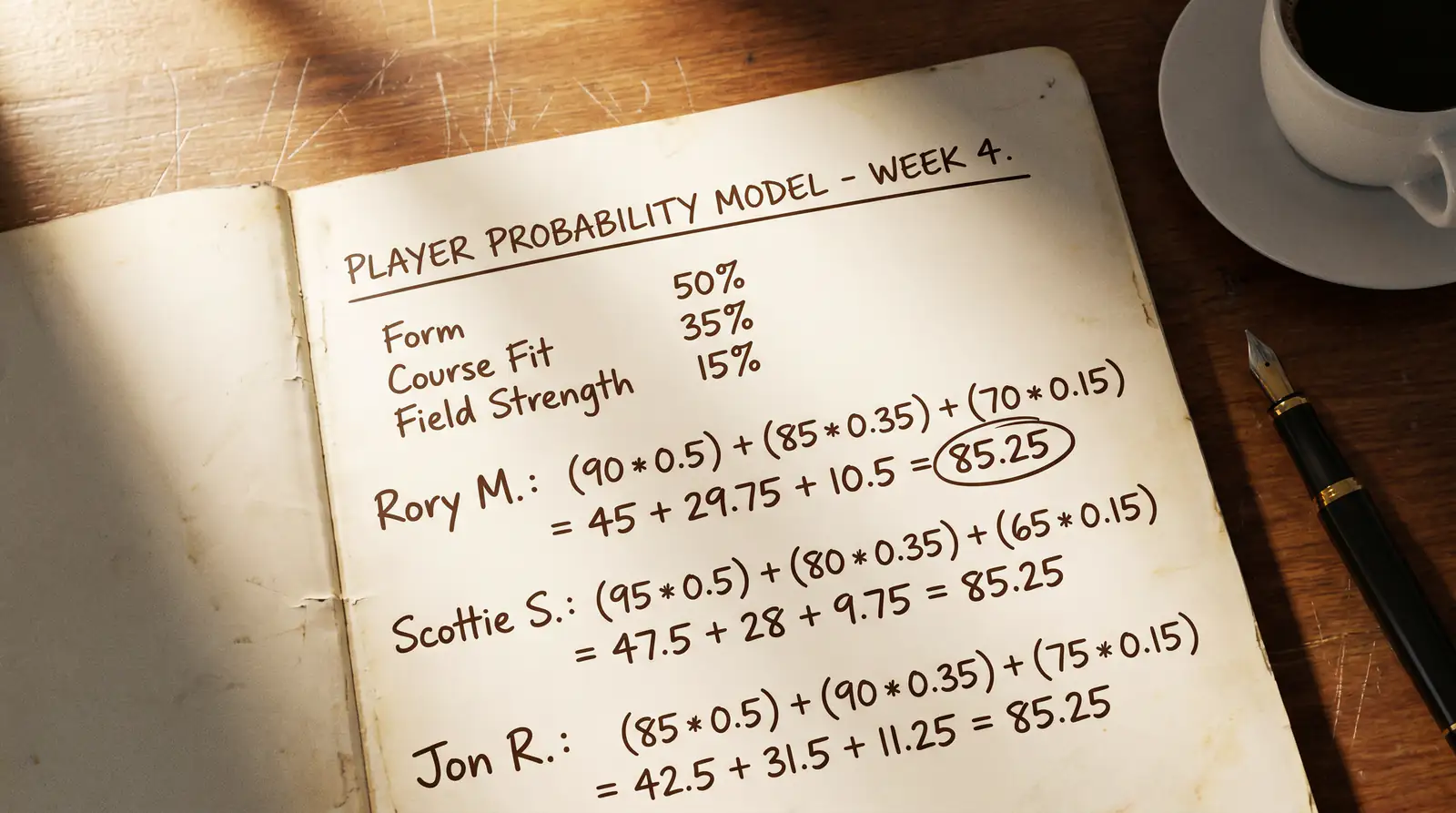
My process is deliberately simple. I assign each shortlisted player a probability based on three weighted factors: current form (SG: Approach and SG: Tee-to-Green over the last eight events), course fit (historical results at the venue and SG alignment with course demands), and field strength (the overall quality of the tournament draw). I weight form at 50%, course fit at 35%, and field strength at 15%. These weightings are not scientifically derived — they emerged from trial and refinement over six seasons — but they provide a consistent framework that keeps my estimates anchored in data rather than gut feeling.
The PGA Tour operates with annual handle growth of 30–35% across several consecutive years, which means pricing models are constantly evolving. My own model does not need to be perfect. It needs to be right more often than it is wrong, and it needs to disagree with the market in ways that the market will eventually correct. A player I estimate at 6% probability who is priced at 4% implied is a value bet — even if my 6% estimate is imprecise. The gap between my number and the market’s number is the edge, and as long as the gap is genuine (not the product of bias or wishful thinking), it generates positive expected value over time.
Comparing Your Numbers to Market Odds
Once I have probability estimates for my shortlist, I convert them to “fair odds” and compare them to the bookmaker’s actual price. The conversion is the reciprocal: a 5% probability equals fair odds of 20/1 (decimal 20.0). If the bookmaker is offering 25/1, the player is overpriced relative to my estimate — and that is a potential bet.
The threshold matters. I do not bet every time my number is marginally higher than the market’s. Golf has too much variance and my estimates have too much uncertainty for tiny edges to be reliable. My minimum threshold is a 25–30% probability gap. If I estimate a player at 5% and the market implies 3.8% or less (25/1 or longer), the gap is roughly 30% and I act. If the market implies 4.2%, the gap is under 20% and I pass. That filter keeps me out of borderline bets where the expected profit is too small to survive the natural noise of 156-player fields.
I run this comparison across three or four bookmakers for each shortlisted player, because prices differ. A player might be 28/1 at one bookmaker and 22/1 at another. The value may exist at one price but not the other. Shopping for the best price is not optional in value betting — it is the mechanism by which you capture the edge your analysis has identified. For the mathematical foundation behind these comparisons, the implied probability guide walks through the conversion formulas and overround calculations in detail.

A Weekly Value-Hunting Workflow
Every Tuesday evening, I spend about 45 minutes on my weekly value scan. The routine has not changed much in five years, which is the point — consistency removes emotion from the process.
First, I pull the confirmed field and note any late additions or withdrawals. Field composition affects every price in the market, so starting with the accurate entry list is non-negotiable. Second, I run my course-fit filter: which players in the field have the SG profile that matches this week’s venue? That typically narrows 156 names to 20–30. Third, I overlay recent form by ranking those 20–30 players by SG: Approach and SG: Tee-to-Green over the last eight events. The top ten to fifteen become my active shortlist.
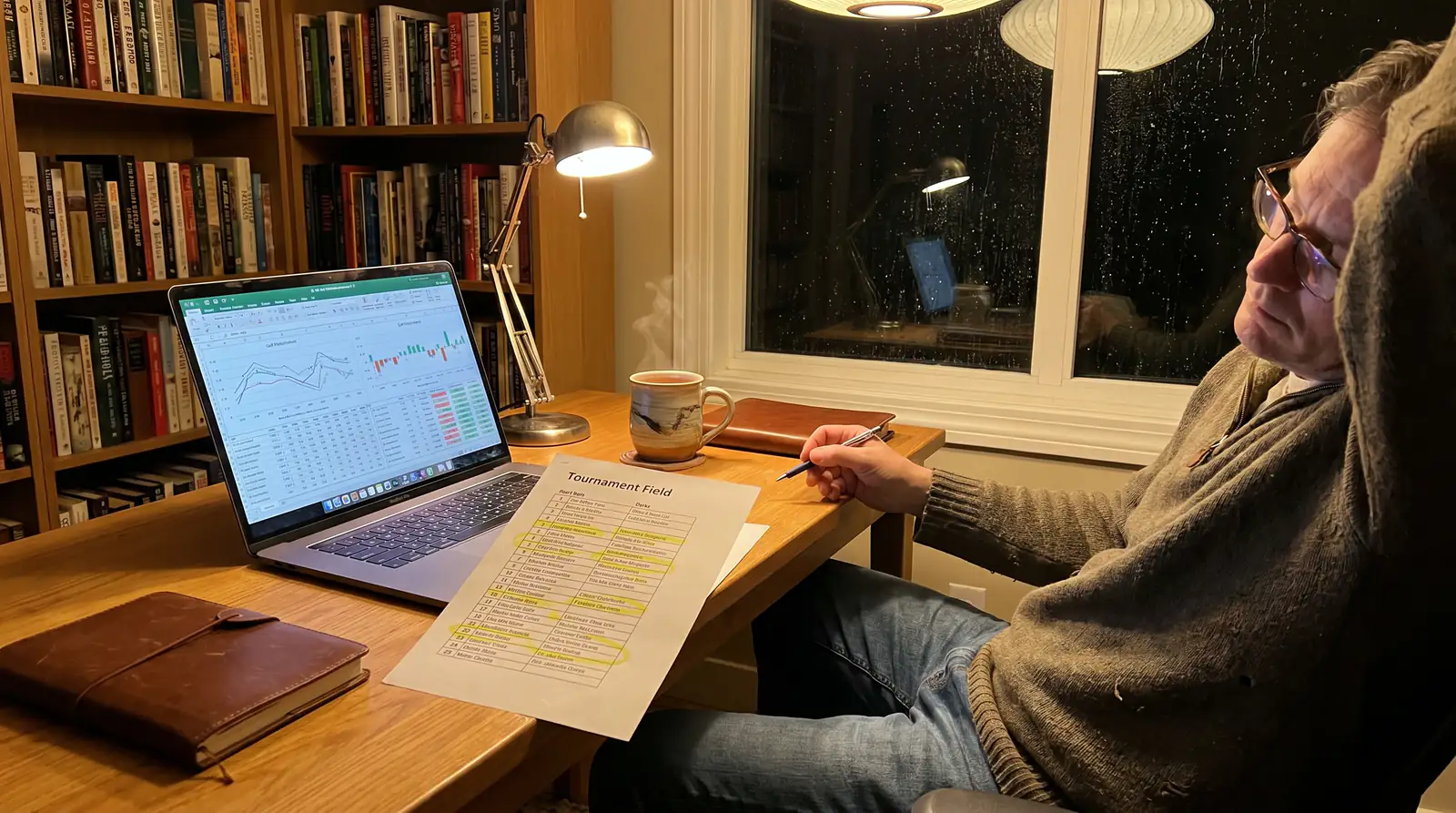
Fourth — and this is the step most punters skip — I assign probability estimates to each shortlisted player before looking at any odds. I write the numbers on paper. Only after the estimates are recorded do I open a bookmaker’s site and compare. This sequence prevents anchoring. If I see a player at 18/1 before estimating their probability, my brain will unconsciously nudge my estimate toward the implied 5.5%. By estimating first, I keep the analysis clean.
Fifth, I identify bets where my estimate exceeds the implied probability by at least 25–30%. Those go on the slip. Typically, I end up with two to five bets per week — sometimes fewer, occasionally more if the field and course produce multiple mismatches. If the scan produces zero bets, I do not bet that week. The discipline to sit out a week with no value is as important as the discipline to act when value appears.
The final step is staking. Each bet is sized according to the fractional Kelly criterion, based on the estimated edge. A larger edge gets a larger stake; a marginal edge gets a smaller one. Over a full season of 35–40 betting weeks, this workflow produces a clear record that I can audit for accuracy. The audit tells me whether my probability estimates are calibrated (are 5% estimates winning close to 5% of the time?) and whether the value is real or imagined. That feedback loop is what makes value betting a system rather than a theory.


Value Betting FAQ
How large a sample size do I need before trusting my own golf probability model?
At minimum, 150 to 200 bets over a full season before drawing conclusions about your model’s accuracy. Golf’s high variance means that even a well-calibrated model can show negative results over 50 bets purely due to randomness. Track every bet, record your estimated probability and the bookmaker’s implied probability, and review after each 50-bet block. Calibration — whether your 5% estimates win roughly 5% of the time — is the key metric.
Can value betting work with each-way bets or only outright win markets?
Value betting applies to any market where you can estimate the probability and compare it to the bookmaker’s price. Each-way bets have two components — win and place — and each can be assessed for value independently. I often find that the place part of an each-way bet carries more value than the win part, especially for players in the 25/1 to 66/1 range with strong top-ten credentials but limited win probability.
