
 Available in US
Content
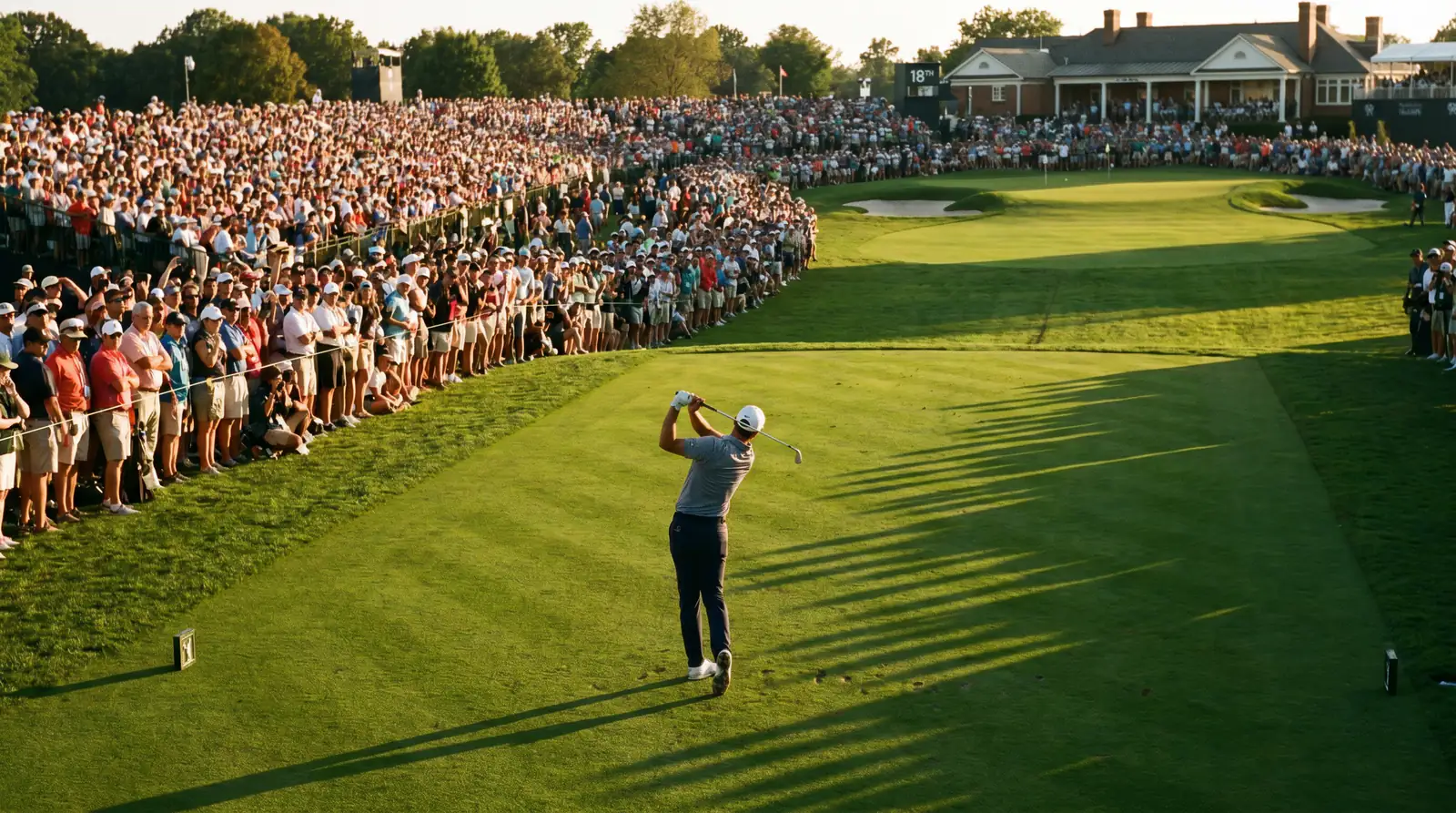
The Flagship Bet: Picking a Tournament Winner
I placed my first outright golf bet in 2017 — a tenner on a 66/1 shot at the Scottish Open who missed the cut by four strokes. Nine years on, outright betting still accounts for most of my golf wagers, and I have learned more from those early disasters than from any winner I have backed since. The outright market — also called “tournament winner” or “to win outright” — is the simplest bet in golf: you pick one player to lift the trophy, and if they do, you collect.
Simple does not mean easy. The PGA Tour’s total prize pool for 2026 sits at $450 million, with every Signature Event carrying a $20 million purse. That kind of money attracts the deepest fields in professional sport, which is precisely why outright golf odds dwarf anything you will find in football or tennis. A tournament favourite might open at 8/1 or 10/1. Mid-tier contenders sit anywhere from 25/1 to 80/1. And the tail of the field — the players ranked 100th and below — can drift past 200/1. That range is the entire appeal: a well-researched outsider can return life-changing money from a modest stake.
Yet the market’s width also makes it brutally hard to beat consistently. Understanding how outright markets are structured, when to place your bet, and how to shrink a 156-player field into a sensible shortlist is the difference between punting blind and betting with an edge.
How the Outright Market Is Structured
Last summer, I pulled up the outright market for The Open Championship the moment it was posted — three weeks before the first tee shot. The field listed 156 players, each with individual odds. That is not a typo. Bookmakers price every single entrant, and the combined implied probabilities of all those prices add up to well over 100%. The gap between that total and 100% is the overround — the bookmaker’s built-in margin.
In a typical PGA Tour event, the overround on the outright market can range from 120% to 140%, sometimes higher. Compare that to a two-horse race where the overround might be 105%. The sheer number of runners in golf means the bookmaker bakes in a thicker margin, and it is spread across every price. A player quoted at 40/1 might have a “true” probability closer to 50/1 once you strip out the margin. That difference matters over dozens of bets across a season.
The market structure also means that big chunks of the total probability sit in the long tail. Players priced between 80/1 and 300/1 collectively account for a significant slice of the book. Bookmakers cannot research every mid-pack player with the same depth they apply to the top 20, which is exactly where pricing inefficiencies tend to appear. I have found more value in the 40/1 to 100/1 range than I ever have backing single-digit favourites — though backing a favourite is sometimes the right play when the data screams it.

Ante-Post vs Day-of-Tournament Pricing
There is a quiet window every Monday evening when the next week’s outright market first appears. The field is not always confirmed, withdrawals have not happened, and the odds compilers are working from preliminary entry lists. I call it the “soft market” window, and it is where I do a disproportionate amount of my ante-post work.

Ante-post — from the Latin “before the post” — means betting before the event begins, sometimes weeks in advance. The key trade-off: ante-post prices are often more generous because the bookmaker carries the risk of non-runners. If your player withdraws before round one, your stake is lost in most ante-post markets. No refund, no void. That is the price you pay for the better odds.
Day-of-tournament pricing, by contrast, reflects confirmed starters. Withdrawals are settled as void bets, your stake returned. But the odds are shorter. When Scottie Scheffler won The Open Championship 2025 and collected $3.1 million from a $17 million purse, his ante-post price earlier that month was noticeably wider than the morning-of-tournament quote.
My rule of thumb: if I have strong conviction on a player and the event is a full-field tournament with low withdrawal risk, I take the ante-post price early. For majors, where late withdrawals are rare because nobody pulls out of a major voluntarily, ante-post is almost always the sharper play. For regular tour stops with smaller purses, I tend to wait until the Tuesday or Wednesday when the field is locked. The extra information — who is actually teeing it up, what the practice-round buzz says — sometimes outweighs the price difference. For a deeper look at season-long ante-post angles, the golf futures betting guide covers FedEx Cup and Order of Merit markets in detail.

Filtering 156 Players to a Shortlist
I once tried to handicap an entire 156-player field from scratch. It took the better part of a Sunday afternoon, and by the time I finished, half the data I had used was already stale. The lesson: you need a system for cutting the field quickly, not a method for analysing everyone.
My filtering process runs in three passes. First, I eliminate players who have no realistic chance based on current form and ranking — typically anyone outside the top 100 in the Official World Golf Ranking who has not shown a result in the last eight weeks. That alone cuts the field by 30 to 40 names. Second, I apply a course-fit filter. Every course rewards a different skill mix. A tight, tree-lined layout demands accuracy off the tee; a wide-open links course rewards distance and scrambling. I match each remaining player’s Strokes Gained profile to the course demands, keeping only those whose strengths align. Third pass is the value screen: I compare my rough probability estimate for each shortlisted player against the bookmaker’s implied probability. If my number is materially higher, that player makes the final shortlist. If it is close or lower, they drop off.

The final shortlist usually holds five to ten names — sometimes fewer. From there, I decide how to allocate stakes. Backing three or four players outright in the same event is not unusual in golf, provided each bet represents genuine value rather than a scattergun approach. The key discipline is staking. No single outright bet should carry more weight than your bankroll plan allows, because even a well-researched shortlist will produce far more losers than winners across a season. That variance is baked into the sport. Accepting it is the first step toward profiting from it.

Outright Betting FAQ
What happens to my outright bet if the player withdraws before the tournament?
In most ante-post markets, a withdrawal before the event means you lose your stake — the bet stands regardless. If you placed the bet after the non-runner market closed and the bookmaker offered ‘with a run’ terms, the bet is typically voided and your stake returned. Always check whether the market is ante-post or day-of-tournament before placing the bet.
Is it worth backing a longshot outright in a major championship?
It can be, but only when the data supports it. Major fields are smaller — the Masters invites roughly 90 players, not 156 — so longshots have a statistically better chance than in a full-field event. That said, the standard of competition is higher. A longshot with strong course form, a rising Strokes Gained trend and a price above 80/1 at a major can represent genuine value, but it should be a small-stake play within your overall bankroll plan.
