
 Available in US
Content

Why Most Golf Punters Lose — and How a Strategy Fixes That
Three years into my golf betting career, I sat down with a spreadsheet and reviewed every bet I’d placed in the previous twelve months. The result was grim: 340 bets, a net loss of 14% of my starting bankroll, and absolutely no discernible pattern to what I’d been doing. Some weeks I backed five players, some weeks I backed one. Some weeks I studied form for hours; others I punted on a name I recognised. I wasn’t betting — I was gambling. There’s a difference.
Most golf punters lose for the same structural reason: they treat each tournament as an isolated event rather than one round in a long-term game. They back players because of a hot recent finish, a commentator’s endorsement or a gut feeling about Augusta. They vary their stakes based on confidence rather than a mathematical framework. And they never review whether their approach is actually working. The PGA Tour has seen 30-35% annual handle growth over several consecutive years, which means more money is flowing into these markets every season — but more money doesn’t mean more informed money. A significant portion of that growth is recreational punters repeating the same unstructured mistakes week after week.
A strategy fixes this by turning betting into a repeatable process with defined inputs, consistent execution and measurable outputs. It doesn’t guarantee profits — nothing does in a 156-player field where the favourite has an 8% chance of winning — but it eliminates the errors that make long-term profitability impossible. Think of it as the difference between a golfer who hits balls randomly on the range and one who follows a structured practice plan. Both hit the same number of balls. One gets better.
What follows is the framework I’ve refined over nine years. It breaks the betting process into four steps — tournament selection, field analysis, data-driven research and staking — then stitches them together into a weekly routine. Each step has clear criteria. Each produces a specific output. And each is designed to compound small edges over time rather than chase the thrill of a single big win.
Step 1: Picking the Right Tournaments to Bet
Not every tournament is worth your money. That’s the first lesson I wish someone had drilled into me before I started spreading bets across 35 events a season like confetti. Some weeks the betting landscape offers genuine edges. Other weeks the fields are weak, the data is thin, or the course is so unfamiliar to analysts that the market is essentially a coin flip with bad odds. Learning to sit out is a strategic skill, not a weakness.
Golf’s reach has never been broader — 108 million adults and juniors now play the sport across R&A-affiliated territories, a figure that’s grown by roughly three million since 2023. That growing audience feeds a global viewership topping 450 million, which in turn drives betting interest. But the volume of available events doesn’t mean they all merit a wager. The PGA Tour alone runs more than 40 events per season, plus the DP World Tour, LIV Golf, and a stack of smaller tours. Trying to bet on all of them is a recipe for mediocrity.
My tournament selection process starts with three filters. First, field strength: is the event attracting a full complement of ranked players, or is it a low-purse week where the top names rest? Stronger fields paradoxically offer better betting value because the market is more efficient at the top and less efficient in the middle — bookmakers dedicate more pricing resources to marquee events, but the depth of the field creates exploitable gaps at the 40/1 to 100/1 range. Second, data availability: do I have reliable Strokes Gained splits, course history and recent form metrics for the venue? If a tournament is being played at a new or redesigned course, the historical data is thin and my edge evaporates. Third, market depth: are multiple bookmakers pricing a full range of each-way, matchup and top-finish markets? If only outright winner and a thin matchup card are available, the opportunity set is too narrow to justify the time investment.
In practice, I typically identify 20-25 events per season that pass all three filters. The majors are always in. Signature Events with elevated fields and deep markets are almost always in. Regular PGA Tour events at returning venues with strong data coverage are in most years. DP World Tour events vary — some (like the BMW PGA Championship) have excellent field strength and data; others are thin on both counts. And I skip nearly all LIV Golf events because market availability from UK bookmakers remains limited and the 48-player field produces odds structures that don’t suit my each-way approach.
Discipline here pays compound dividends. Betting 22 well-researched weeks instead of 40 poorly researched ones means more time per event, better player analysis, and more concentrated capital behind your highest-conviction plays. Every profitable golf punter I know bets fewer events than the average recreational punter. Every single one.
Step 2: Narrowing a 156-Player Field
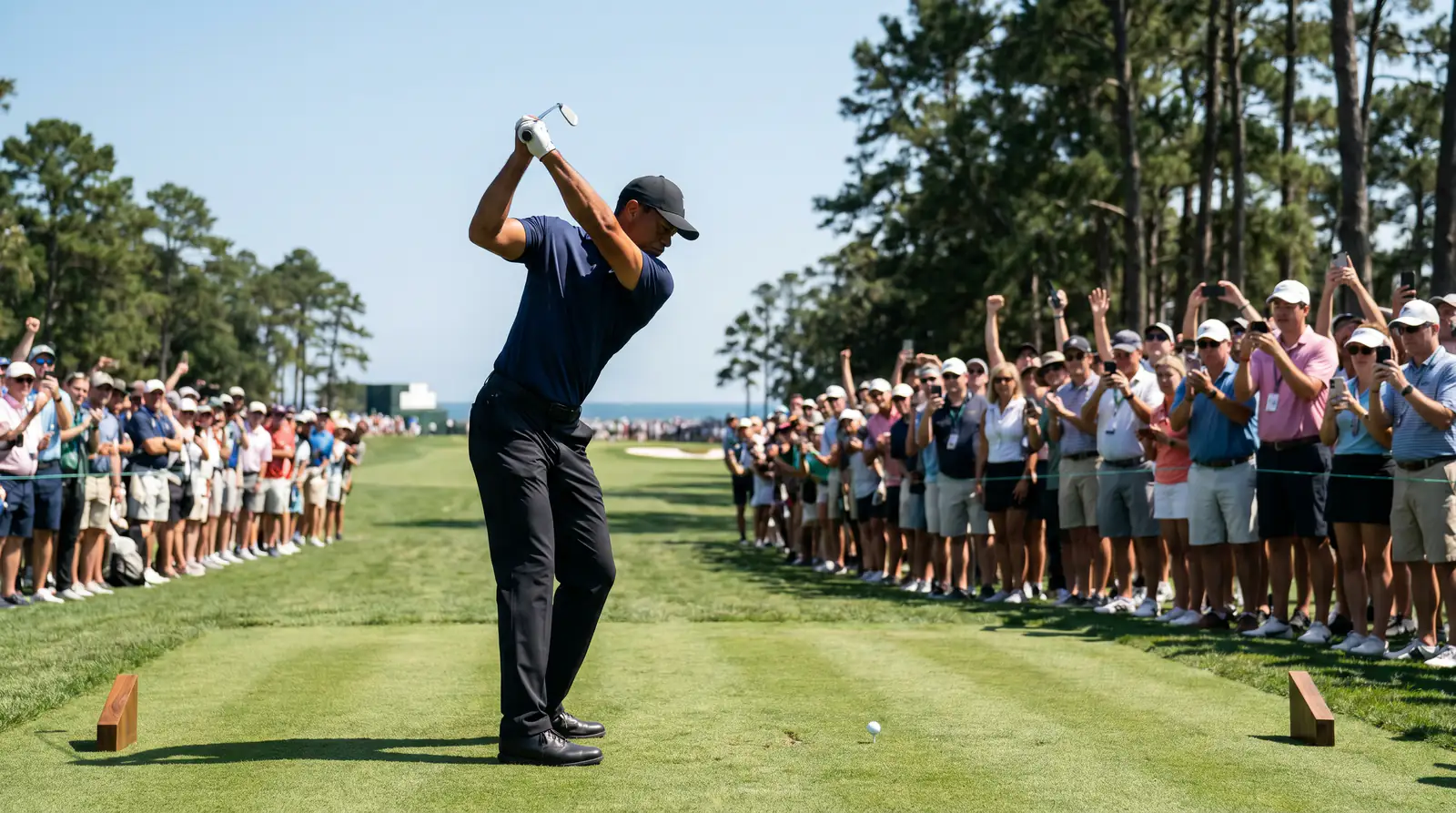
Staring at a list of 156 names and trying to pick a winner is like being asked to find a specific grain of sand on a beach. You need a sieve. The goal of field analysis isn’t to identify the winner — it’s to eliminate the players who almost certainly won’t win, so your attention and capital are focused on the 15-20 who genuinely might.
I start with form recency, but not the way most punters think about it. A top-ten finish two weeks ago tells me a player is in rhythm. A missed cut two weeks ago after a string of top-twenties tells me there might be a physical issue or a course mismatch, but it doesn’t erase months of solid play. The trap is recency bias: overweighting the last result and ignoring the trend. I look at a rolling window of the last 8-12 events, not just the last one. If a player has six top-twenties and two missed cuts in that span, the baseline is strong. If a player has two top-twenties and six missed cuts, no amount of “he’s due” logic should put him on your shortlist.
England alone saw 5.75 million scorecards submitted through the World Handicap System in the first half of 2025, a 29% year-on-year increase. That explosion of participation trickles up — more competitive amateur golf feeds the development tours, which feeds the main tours with deeper talent pools. The practical consequence for bettors is that fields are more competitive than they were even five years ago. There are fewer genuine no-hopers at the bottom of the field and more credible 80/1 to 150/1 outsiders who can go low on any given week. Your sieve needs to be finer.
After form recency, I apply course fit. This isn’t just “he played well here last year.” It’s a profile match between the player’s strengths and the course’s demands. A long, open course that rewards driving distance favours a different player profile than a short, tight layout that rewards accuracy and scrambling. I categorise courses into four archetypes — bomber-friendly, accuracy-premium, all-round and links — and match them against each player’s statistical profile. More on the specific metrics in the next section, but the key insight is that course fit is a filter, not a prediction. It tells you who to exclude, not who to back.
The third filter is mental state and motivation. This is harder to quantify but no less important. A player who just locked up his Tour card for next season has less urgency than one fighting to keep it. A player returning to a course where he’s won before has a psychological lift that statistics don’t fully capture. A player in a contract year, or chasing a first major, or defending a title — these factors influence effort and focus, which influence performance at the margins. I don’t bet on motivation alone, but I use it as a tiebreaker when two players have similar statistical profiles.
By the end of this step, my 156-player field is down to a shortlist of 12-18 players. That’s a manageable number for the deep research that comes next — and a dramatic improvement over the scattershot approach of picking three or four names from the top of the market because they’re household names.

Step 3: Data-Driven Research Beyond the Gut
I once lost a bet I was absolutely certain would win. The player had won the event the previous year, was in brilliant form, and everyone on Golf Twitter said he was the pick of the week. He missed the cut by four shots. When I went back and looked at the data, the story was obvious: the course had been lengthened by 300 yards since his win, and his driving distance ranked 98th on Tour that season. My gut said yes. The data said no. The data was right.
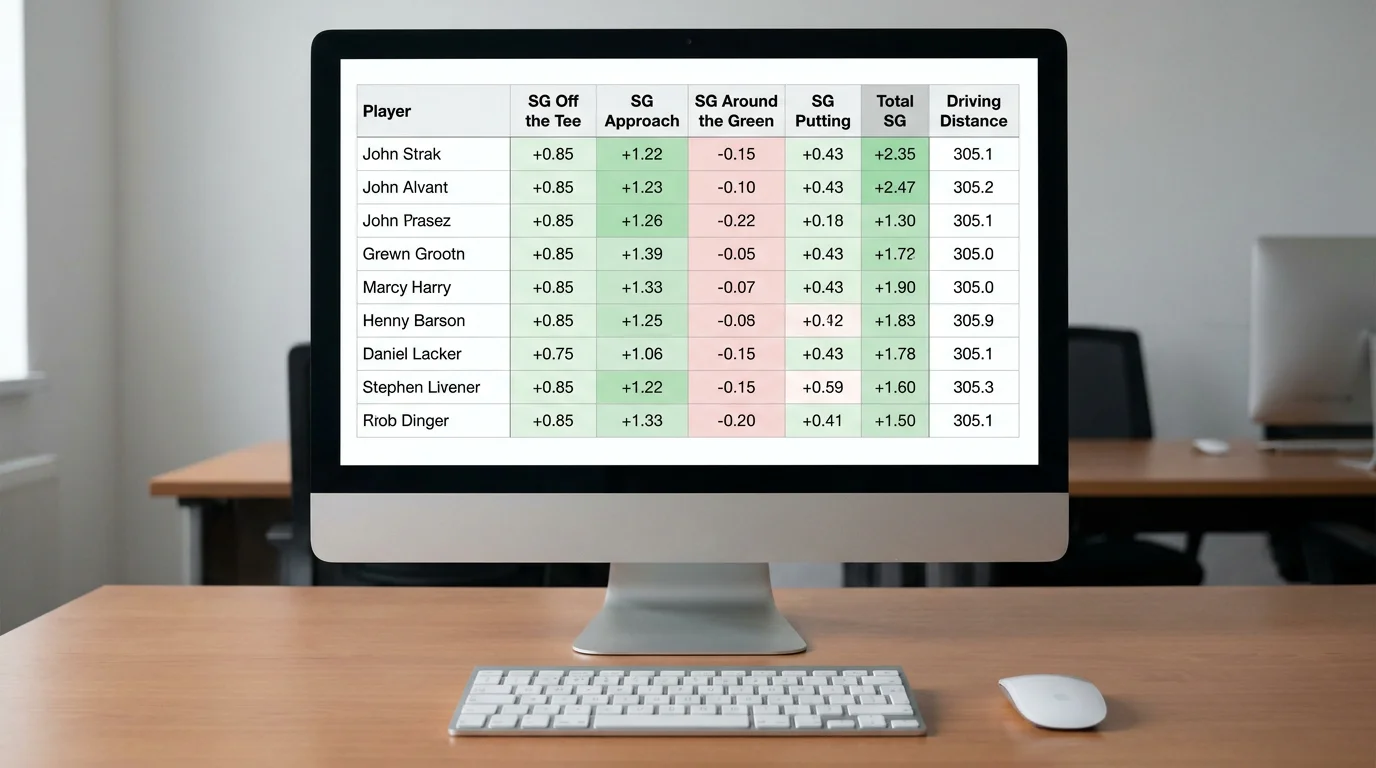
The single most important analytical tool for golf betting is Strokes Gained, the statistical framework developed by Mark Broadie at Columbia University and adopted by the PGA Tour. Strokes Gained breaks a player’s performance into four components: off-the-tee, approach, around-the-green and putting. Each component measures how many strokes a player gains or loses relative to the field average in that skill area. Unlike raw stats like driving distance or greens in regulation, Strokes Gained is adjusted for field strength and course difficulty, making it directly comparable across events.
For betting purposes, the most predictive Strokes Gained categories are approach and tee-to-green. Putting is notoriously volatile — even the best putters have high week-to-week variance — so I weight it lower in my models. SG: Approach tells me how well a player hits iron shots into greens, which correlates strongly with scoring and is relatively stable over rolling 12-24 round windows. SG: Off-the-Tee matters more at specific courses where driving distance or accuracy is at a premium, so I adjust its weighting based on the course archetype I assigned in the field analysis step.
Beyond Strokes Gained, I track three supplementary metrics. Total driving (a composite of distance and accuracy) helps distinguish between long-and-straight players and long-and-wild players — a distinction that matters enormously at courses with punishing rough. Scrambling percentage indicates how well a player recovers from missed greens, which is critical at US Open-style setups where even the best approach players miss greens frequently. And birdie-or-better percentage tells me whether a player can go low when the course allows it, which matters for outright contention in formats where a single hot round can propel someone from the pack into the lead.
The PGA Tour’s VP of Gaming, Scott Warfield, has spoken about trying to “grow the pie and get more people engaged around the sport,” and the 2026 season has more data available to punters than ever before. Free Strokes Gained data is accessible through the PGA Tour’s own website, Data Golf provides more granular splits, and Fantasy National offers predictive models that synthesise multiple data sources. You don’t need to build a statistical model from scratch — but you do need to be reading the data regularly and incorporating it into your assessments rather than relying on narrative, media hype or last week’s leaderboard.
My research output for each shortlisted player is a one-line summary: current SG: Approach rank, course-fit rating, form trend (up/stable/down), and any notable contextual factors. That summary goes into a comparison against the market odds, which is where the final decision to bet or pass is made. No gut. No hype. Just data matched against price.
Step 4: Staking Plans That Survive Variance
Golf is the highest-variance major sport for betting. In football, the favourite wins roughly 45% of the time. In tennis, closer to 65%. In golf, the pre-tournament favourite wins about 8-12% of the time. That means you’ll lose far more often than you win, even with excellent selection. If your staking plan can’t absorb long losing streaks, your strategy is dead before it starts.
I use a flat-staking approach with one modification. Every bet is sized at 1% of my current bankroll. Not 1% of my starting bankroll — 1% of whatever my bankroll is right now. This means stakes naturally decrease during losing runs and increase during winning ones, which provides an automatic brake on drawdowns without requiring me to make emotional decisions about bet sizing. The modification is that I allow a half-unit (0.5%) bet for lower-conviction plays and a 1.5-unit bet for the handful of spots each season where my data gives me unusually high confidence. That’s the maximum. No exceptions.
Why 1% and not 2% or 3%? Because the maths of ruin are unforgiving at higher stakes. A 20-bet losing streak in golf is not unusual — I’ve had several over nine years, and the longest was 27 consecutive losses. At 1% per bet, a 27-loss streak reduces your bankroll by roughly 24% (because the stakes shrink as the bankroll drops). At 2%, the same streak costs you 42%. At 3%, you lose 56%. The difference between a manageable drawdown and a catastrophic one is just one percentage point of unit size.

Some punters prefer the Kelly Criterion, which sizes bets proportionally to the perceived edge. Kelly is mathematically optimal in the long run, but it requires accurate probability estimates — and in a 156-player field, accurate probability estimation is incredibly difficult. Even small errors in your probability inputs can lead Kelly to recommend oversized stakes that amplify losses rather than profits. I’ve found that fractional Kelly (typically quarter-Kelly, so one-quarter of the full Kelly recommendation) works as a useful crosscheck against my flat-staking approach, but I wouldn’t recommend full Kelly to anyone who isn’t running a quantitative model with a proven track record.
The single most important staking discipline is consistency. The temptation after a big win is to increase stakes. The temptation during a losing run is to chase. Both impulses destroy bankrolls. Set your unit size at the start of each quarter, based on your current bankroll, and don’t change it until the quarter ends. If your analysis is sound and your selections have positive expected value, the maths will do the rest. You just have to give it time.
Putting It Together: A Weekly Betting Routine
Every Tuesday morning, before the first practice round tee times are posted, I open the same spreadsheet I’ve used for four years. It has tabs for this week’s event, a player database, a form tracker and a results log. The routine takes about 90 minutes, and it follows the same sequence every week. No shortcuts.
Tuesday: event check. I confirm the tournament passes my selection filters (field strength, data availability, market depth). If it doesn’t, I note the reason and move on. No betting this week. If it does, I pull the confirmed field list and identify which players on my watchlist are competing.
Wednesday morning: field analysis. I run each player on my watchlist through the form recency, course fit and motivation filters described above. This typically narrows the field to 12-18 candidates. For each candidate, I pull their rolling Strokes Gained splits, recent finishing positions and course history. I write the one-line summary for each and rank them by overall profile strength.
Wednesday afternoon: market comparison. I check the outright and each-way odds across three or four bookmakers for my shortlisted players. I compare each player’s market-implied probability against my own assessment. If my assessment says a player has a 5% chance of a top-five finish and the market is pricing him as if he has a 2% chance, there’s a potential edge. I flag any discrepancies above a threshold (typically 30% or more between my probability and the market’s).
Thursday morning: final bets. I review my flagged bets one more time against the latest news — tee times, weather forecasts, any withdrawal announcements. Then I place the bets. Typically three to five wagers per event: a mix of each-way, top-finish and occasionally a matchup where my data gives me strong conviction on one side. All at my pre-set unit size.
Sunday evening: review. I log every bet’s result, calculate the week’s P&L, and note anything I’d do differently. Did I miss a player who outperformed my model? Did a course-fit assessment prove wrong? These notes feed back into the following week’s process. The routine compounds: every week’s review makes the next week’s analysis marginally better.

The entire process is boring. That’s the point. Profitable golf betting isn’t exciting — it’s systematic. The excitement comes from the results, not the process. And if you’re getting your excitement from the process — from the thrill of picking a player, from the buzz of placing a bet — you’re gambling, not investing.
Strategic Errors That Drain Bankrolls
After reviewing hundreds of conversations with fellow golf bettors and dissecting my own early mistakes, the same errors surface again and again. They’re not exotic or complicated. They’re simple, boring and devastatingly expensive.
Backing too many players in a single event is the most common. If you’ve backed six outright selections in the same tournament, you’ve essentially guaranteed that at least five of them lose. The combined stake across six bets is substantial, and the probability that any one of them wins barely moves the needle enough to justify the outlay. I cap myself at five wagers per event, and most weeks I’m at three.
Ignoring course fit is the second. A player on a heater — three top-tens in a row — is irresistible to the average punter. But if those results came on parkland courses and this week’s event is at a links, the form is barely relevant. Course demands are specific enough that a player’s recent results at different venue types are poor predictors. I’ve tracked this: when I ignore course fit and bet on raw form alone, my hit rate drops by roughly 40%.
Chasing losses mid-tournament is the third. Your outright pick misses the cut on Friday, so you pile into an in-play bet on Saturday to recover the loss. This is emotional decision-making dressed up as strategy. The in-play bet wasn’t on your shortlist, wasn’t part of your pre-tournament analysis, and exists solely because you want to feel less bad about the loss. That’s a gambling impulse, not a strategic one. Walk away. The next tournament is seven days away, and your bankroll will still be there.
Finally, neglecting to track results. If you can’t tell me your strike rate, your average return per bet and your P&L over the last 100 bets, you don’t have a strategy — you have a hobby. Tracking forces accountability. It reveals whether your edges are real or imagined. And it gives you the data you need to refine the process over time. A ten-minute review on Sunday evening is the highest-ROI habit in golf betting.

Golf Betting Strategy FAQ
How many tournaments per season should I bet on for optimal returns?
There is no universal number, but most profitable golf bettors I know target 18-25 events per season out of the 40-plus available on the PGA Tour alone. The key filter is data quality: only bet events where you have reliable course history, Strokes Gained splits and sufficient market depth. Betting fewer events with deeper research consistently outperforms spreading thin across the full calendar.
Is it better to specialise in one tour or spread bets across PGA and DP World Tour?
Specialisation helps if your data pipeline is limited. The PGA Tour has the deepest publicly available statistics, making it the easiest to analyse quantitatively. The DP World Tour offers thinner data but also thinner markets, which can mean less efficient pricing and more exploitable edges for those who do the homework. I primarily focus on the PGA Tour and add a handful of DP World Tour events where field strength and data coverage justify the effort.
How far in advance should I place ante-post golf bets?
Ante-post prices are typically most generous six to eight weeks before a major championship, when field confirmation is incomplete and bookmakers are hedging against a wide range of outcomes. For regular tour events, I rarely bet more than one week in advance. The risk of withdrawal, injury or form collapse increases with time, and ante-post bets are usually void-if-not-competing only at some bookmakers. Check the specific void rules before placing early.
What percentage of my bankroll should a single golf bet represent?
I use 1% of current bankroll as my standard unit, with 0.5% for lower-conviction plays and 1.5% as an absolute ceiling for the strongest spots. At these levels, even a prolonged losing streak of 25-30 bets reduces the bankroll by a survivable amount. Anything above 2% per bet introduces serious ruin risk given the high variance inherent in golf betting.
