
 Available in US
Content

Ties Happen More Than You Think in Golf
The bet that taught me about dead heat rules cost me exactly half of what I thought I had won. It was a top-five finish market at a European Tour event, and my player finished in a three-way tie for fourth. I expected a full payout. What arrived in my account was a fraction of it. That gap between expectation and reality is why dead heat rules matter — and why most golf bettors I speak to still do not fully understand them.
Golf is structurally prone to ties. A 156-player field competing over 72 holes on the same course produces clusters of identical scores far more often than most sports. The PGA Tour has recorded 20% year-on-year handle growth in 2025 — the fourth consecutive year of double-digit increases — and with that growth comes a wave of newer punters encountering dead heat settlements for the first time. The confusion is predictable, but the maths is not difficult once you see it laid out.
Dead heat rules apply whenever two or more players finish level in a market where only a specific number of positions pay out. Outright winner markets with a play-off are a different beast — more on that below. But in top-five, top-ten, top-twenty, and place markets, ties at the boundary trigger a dead heat reduction, and that reduction follows a precise formula.
How the Dead Heat Rule Reduces Your Payout
The formula is disarmingly simple, yet I have seen it misunderstood in betting forums for years. Here is how it works.
When a dead heat occurs, the bookmaker divides the number of paying positions available at the tied rank by the number of players sharing that rank. That fraction is then applied to your potential payout. If three players tie for the last two paying positions, you get two-thirds of your full winning return. If four players tie for one remaining place, you receive one-quarter. The principle is always the same: available places divided by tied players.
The UK gambling industry generated total gross gaming yield of GBP 11.5 billion in the year to March 2024, and the bookmakers operating within that market apply this rule consistently. It is not a discretionary decision or a house edge trick — it is a standard settlement mechanism codified in every major operator’s terms and conditions.
What catches people out is that the reduction applies to the full returns, not just the profit portion. If you placed a GBP 10 bet at 20/1 on a player to finish in the top five, the full return would be GBP 210 (GBP 200 profit plus GBP 10 stake). In a dead heat, the reduction applies to that entire GBP 210 figure. After the reduction, you receive the adjusted amount minus any stake adjustment. It sounds fiddly in the abstract, so let me walk through specific scenarios.
Worked Example: Two-Way Tie
Picture this: you have backed Player A at 14/1 to finish in the top five. He finishes in a tie for fifth with one other player. Two players are sharing the one remaining paying position.
Step one: calculate the full return as if the bet had won outright. A GBP 10 stake at 14/1 returns GBP 150 (GBP 140 profit plus GBP 10 stake).
Step two: determine the dead heat fraction. One paying position is available, and two players are tied for it. The fraction is 1/2.
Step three: apply the fraction to the full return. Half of GBP 150 is GBP 75. That is your total payout — GBP 65 profit and GBP 10 in stake adjustments (you effectively “lose” half the stake as well, since the reduction covers the entire return).
A two-way dead heat is the mildest scenario. You still pocket a meaningful return. The damage escalates rapidly when more players are involved.

Three-Way and Four-Way Dead Heats
Same setup: GBP 10 at 14/1 on a top-five finish. But now three players tie for fifth, and only one paying position remains.
The dead heat fraction becomes 1/3. One-third of the GBP 150 full return is GBP 50. Your profit drops from GBP 140 (no dead heat) to GBP 40. That is a 71% reduction in profit — from a bet that technically “won.”
A four-way tie for one remaining position cuts even deeper. One-quarter of GBP 150 is GBP 37.50. Your profit shrinks to GBP 27.50. At that point, you have done the research, identified the right player, watched them deliver a top-five-worthy performance, and walked away with less than a fifth of what the headline odds promised.
This is why I always factor dead heat probability into my staking. Markets with narrow boundaries — top five, first round leader — carry higher dead heat risk than broader markets like top twenty. The narrower the boundary, the more likely you are to share the payout. Scott Warfield, the PGA Tour’s Vice President of Gaming, has spoken about the “stickiness” of golf bettors who engage with the sport’s unique markets — “We feel pretty confident based on the stickiness that we saw last year that if we can get people in, they stay.” That retention depends partly on punters understanding the rules before the settlement arrives, not after.
Dead Heats in Each-Way Bets
If standard dead heats are confusing, the each-way version is where I see the most bewildered faces. An each-way bet is really two bets — a win part and a place part — and a dead heat can affect each part differently.
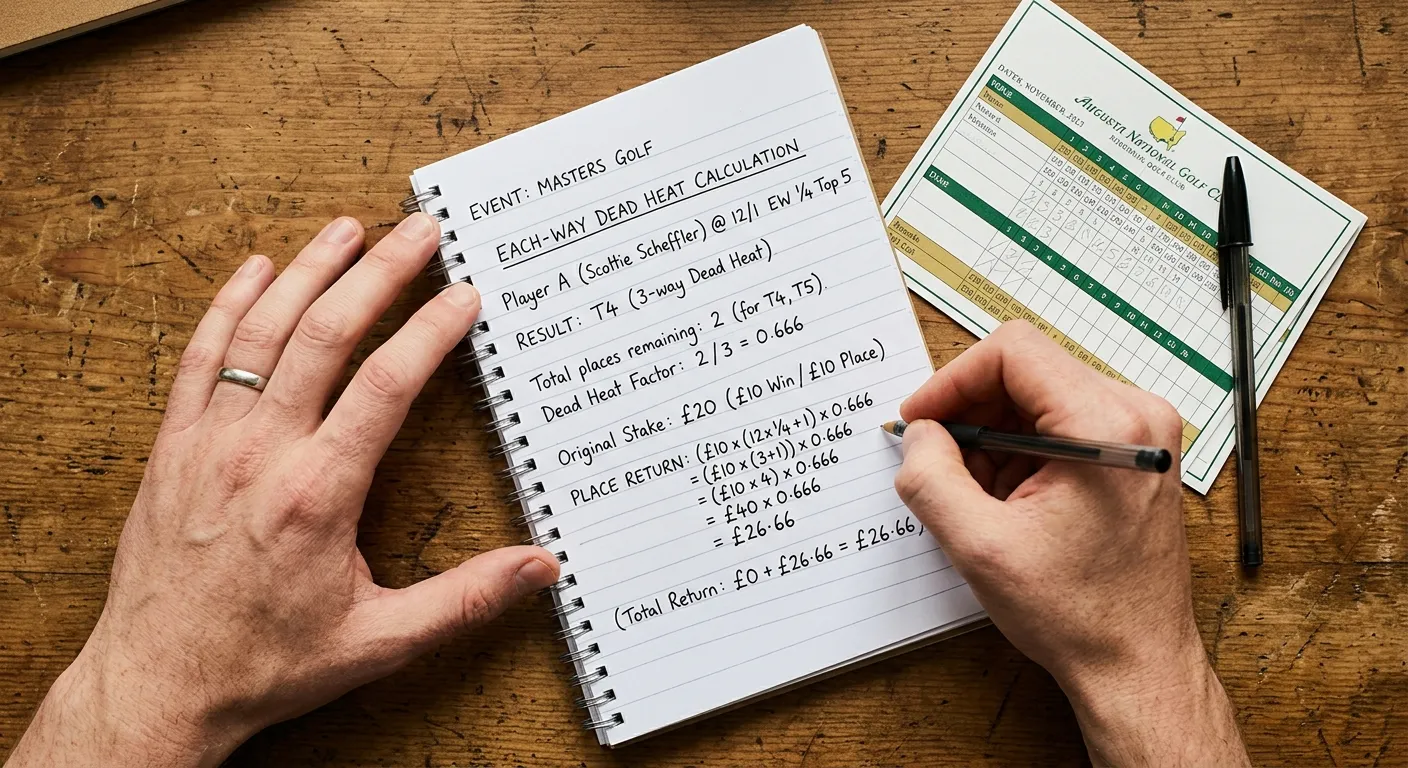
Suppose you back a player each-way at 40/1 with place terms of 1/4 the odds for five places. Your total stake is GBP 20 (GBP 10 win, GBP 10 place). The player finishes in a two-way tie for fifth.
The win part loses outright — the player did not win the tournament. So the GBP 10 win stake is gone.
The place part is where the dead heat applies. At 1/4 of 40/1, the place odds are 10/1. A full place win would return GBP 110 (GBP 100 profit plus GBP 10 stake). With a two-way dead heat, the fraction is 1/2 (one remaining place, two players). Half of GBP 110 is GBP 55. That is your total each-way return: GBP 55 from the GBP 20 total outlay.
Now change the scenario: three players tie for fourth, with two paying positions remaining. The dead heat fraction is 2/3 (two positions shared among three players). Two-thirds of GBP 110 is GBP 73.33. A meaningfully better outcome — which illustrates why the number of available positions relative to tied players is the critical variable, not just the number of tied players alone.
The maths is not guesswork. Before I place any each-way bet in a top-five or top-ten market, I estimate the likelihood of a dead heat at the boundary and adjust my expected value calculation accordingly. It does not take long — a quick glance at historical results for the event usually tells me how clustered the scoring tends to be around those positions. If the event routinely produces bunched leaderboards, I factor in a dead heat haircut of 20–30% on the place part of the expected return. If the event tends to produce separated finishes, the haircut is smaller. Either way, the adjustment is non-negotiable.
Dead Heat Rules FAQ
Does a dead heat apply to outright winner bets if there is a play-off?
No. In professional golf, ties for first place after 72 holes are resolved by a play-off. The play-off winner is the outright winner for betting purposes. Dead heat rules only apply to outright bets if the event rules do not include a play-off — which is extremely rare on major tours. For all standard PGA Tour, DP World Tour and major championship events, a play-off settles the outright market cleanly.
How is a dead heat payout calculated when three players tie for fifth?
Count how many paying positions remain at that rank — if the market pays the top five and positions one through four are filled, one position remains. Divide that by the number of tied players: 1 divided by 3 gives a fraction of one-third. Multiply your full potential return by one-third. On a GBP 10 bet at 14/1, the full return would be GBP 150, so the dead heat return is GBP 50.
